
Target
petrichor
Free term-and-meaning mnemonic tool
Connect an unfamiliar term to a familiar sound cue, link that cue to the exact meaning, and then retrieve the pair in both directions. The trainer separates semantic self-checking from exact target spelling and focuses repair on links that still need work.
A complete keyword mnemonic has two links: the unfamiliar term to a familiar sound cue, then the sound cue to the intended meaning.
Use guided English terms or enter private target-meaning pairs of your own.
Use the localized suggestion or edit it. The cue only needs to approximate enough of the target sound to bring the real term back.
Optionally describe a concrete interaction, verbal link, sound, or action that makes the intended meaning specific.
Recall the meaning from the target, then type the exact target from the meaning. Reveal the keyword only when needed.
Revise only weak or assisted pairs, then retest the complete set in new orders.
For the English term petrichor, meaning the pleasant earthy smell when rain falls on dry ground, pet rock can serve as a sound cue. Picture a rain-soaked pet rock releasing that distinct earthy smell. The pet rock supports the sound, while the wet-earth detail carries the meaning.
English term
Target
petrichor
Sound cue
pet rock
Meaning
earthy smell when rain falls on dry ground
Sound cues are approximate bridges, not pronunciation guides. Check the actual pronunciation separately and learn the target spelling and usage.
A pair is mastered only when you retrieve its meaning and type the exact target without revealing your keyword in either direction.
| Bidirectional mastery | Both directions were correct in the same attempt without an on-screen keyword reveal. |
|---|---|
| Forward meaning recall | You attempted the meaning, revealed the reference, and marked the semantic answer correct. |
| Reverse exact spelling | Your typed target matched after Unicode, whitespace, apostrophe, and case normalization. Diacritics and letters still matter. |
| Improvement after repair | The increase in bidirectionally mastered pairs from the first attempt to the best later attempt. |
The score describes one short practice set. It is not a diagnosis, percentile, general memory score, or promise of lasting retention.
Both modes use the same build, retrieve, repair, and retest loop.
Use 3 or 5 reviewed English terms with English sound cues and definitions.
Enter private target-meaning pairs. The trainer does not generate cues, grade meaning semantically, or save your material.
Return to the original learning material later and retrieve again. This compact tool does not save term sets or schedule reviews.
Targets, meanings, pronunciation data, keywords, interaction notes, answers, pair identifiers, and prompt order stay in the current tab. Everything entered for the practice set is cleared before the aggregate result appears.
Local history stores aggregate counts only. Do not enter passwords, recovery phrases, confidential material, or other secrets into a browser practice tool.
Learn the method
Learn how to choose a sound cue, build the meaning link, verify pronunciation and spelling, practise both directions, add context, and review after time.
Read the Keyword Method guideAnswers about sound cues, semantic self-grading, exact spelling, private pairs, repair, pronunciation, and appropriate use.
It practises building a familiar sound bridge to an unfamiliar term, connecting that bridge to the intended meaning, and retrieving the pair in both directions.
Creating and testing two links per term takes attention. Three pairs provide a short introduction, while five provide a fuller practice set without turning this browser tool into a saved term bank.
Meanings can be expressed with synonyms and different wording. The trainer reveals the reference meaning so you can judge semantic equivalence instead of pretending that a fuzzy algorithm understands your answer.
The typed target is compared by normalized exact matching. Case, compatible apostrophe forms, and repeated whitespace are normalized, but different letters or missing diacritics are not accepted as exact.
No. They are approximate sound bridges. Review the displayed pronunciation, verify it with a reliable dictionary or subject source, and practise the real target rather than replacing it with the cue.
Yes. Enter exactly 3 or 5 unique target-meaning pairs. Your pairs and cues stay in the current tab and are not added to local history, analytics, URLs, or result images.
Only pairs missed, misspelled, or answered after a keyword reveal are shown. You can revise their private keyword or interaction, then retest the full set in fresh orders.
No. It shows performance on one short set under the current conditions. Lasting learning requires later retrieval and correct use in the context where the material matters.
Read the full method, compare mnemonic techniques, and keep conclusions tied to the material you practised.
Learn the Keyword Method for unfamiliar terms: compare self-created and suggested sound cues, link one to meaning, retrieve both ways, and review later.
Learn how mnemonic devices work and when to use chunking, chaining, memory palaces, peg systems, acronyms, and more, with step-by-step examples.
Learn how to benchmark cognitive training progress with time, accuracy, mistakes, consistency, streaks, and Quartenson community and this-device comparisons.
Compare paired-term retrieval with linked stories, meaningful groups, and visual pattern recall.
Story Chain Memory Trainer
Link items into one connected story
Build • Recall • Repair
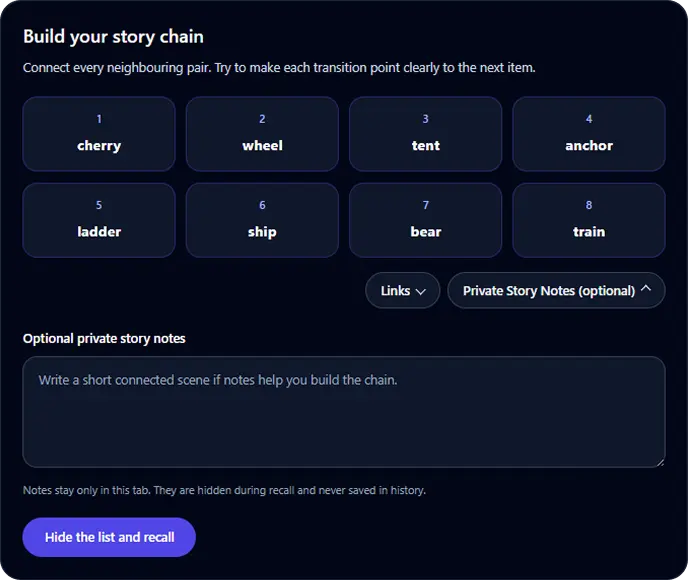
Goal: Recall a short ordered list through connected links
Build a connected story for 4 to 8 items, hide the list, recall it in order, identify the first broken link, and retest after focused repair.
Start Story Chain TrainerChunking Memory Trainer
Group, recall, and reconstruct
Meaningful groups • Exact order • Repair
Meaningful groups
Goal: Recall an ordered list through meaningful groups
Practise 6, 9, or 12 words, digits, or private custom items. Build useful groups, hide the list, reconstruct every position, compare chunks, and repair weak groups.
Start Chunking TrainerVisual Memory Test
Remember sequences or patterns
Memory • Focus • Levels
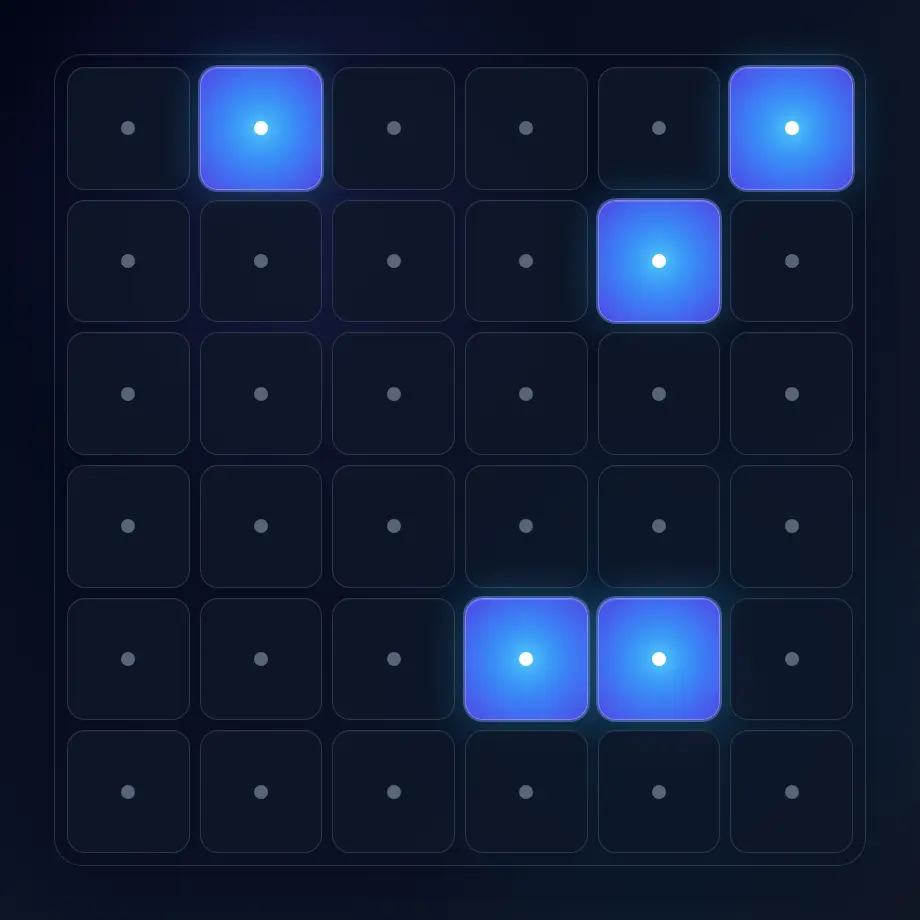
Goal: Better visual sequence and pattern recall
Choose ordered sequence or 3-second pattern recall, progress through levels, choose difficulty, track your best level, and compare recent local sessions.
Start Memory Test