
Peg System
Use for direct access to a short item by its numbered position.
Free mnemonic practice tool
Learn permanent numbered pegs, connect each peg to one temporary target, and test whether any number can retrieve its target directly. The trainer separates unaided answers from answers given after revealing the peg, then helps you repair weak positions and retest the full list.
The number and peg stay fixed. Only the target changes. Random-position recall checks the direct path from number to peg to target.
Use a generated list or enter exactly the selected number of unique targets. Five targets use positions 1-5, while ten use the full beginner set.
Check that each number brings its peg to mind. The peg words and positions remain unchanged between lists.
Make every target act on its peg or visibly change it. Preserve the exact target instead of replacing it with a vague category.
Answer one numbered position at a time. Reveal the peg only when the number does not produce it, and the response will be recorded as assisted.
Rebuild every assisted, incorrect, or skipped association, then test the complete list again in a new random order.
This version uses common English number rhymes. The icons are temporary visual reminders. Keep the same peg word and one stable mental image for every future list.
Suppose the targets are passport, toothbrush, charger, headphones, and water bottle. The interaction should make the target part of the peg scene rather than placing two objects side by side.
| Position | Peg | Target | Interaction |
|---|---|---|---|
| 1 | bun | passport | Opening the bun reveals passport pages covered in crumbs. |
| 2 | shoe | toothbrush | The toothbrush scrubs the muddy shoe until foam erupts. |
| 3 | tree | charger | The charger plugs into the trunk and lights every leaf. |
| 4 | door | headphones | Headphones wrap around the handle and make the door dance. |
| 5 | hive | water bottle | The bottle floods the hive while bees surf down the stream. |
The main score counts exact targets retrieved without revealing the peg. A correct answer after a peg reveal is useful progress, but it remains assisted because the number did not complete the full cue path on its own.
| Unaided correct | The number led to the peg and exact target without a reveal. |
|---|---|
| Assisted correct | The exact target was recalled after the permanent peg was revealed. |
| Incorrect or skipped | The peg-target association needs correction or a clearer interaction. |
| Recovered position | A position that was weak initially became correct without a hint later. |
This result describes only the current targets, peg set, and practice conditions. It is not a general memory score, diagnosis, percentile, or proof of lasting improvement.
Use the Peg System when numbered position matters. Choose a different structure when the retrieval task is different.
Use for direct access to a short item by its numbered position.
Use when each item should cue the next item in one short sequence.
Use when a familiar route can provide a larger set of stable locations.
Use for safety-critical instructions, exact wording, or information that must not be missed.
Generated and custom targets, answers, prompt order, and mental associations stay in the current tab. They are not stored in local history, analytics, URLs, or result images.
Local history stores aggregate session results only. Do not enter passwords, recovery phrases, confidential information, or other secrets into a browser practice tool.
Learn the method
Learn the full 1-10 list, see a worked example, compare mnemonic methods, diagnose specific failures, and understand the evidence limits before using pegs for important material.
Read the Peg System guideAnswers about permanent pegs, targets, hints, scoring, privacy, and appropriate use.
It practises linking a short target list to stable numbered pegs and retrieving each target from a randomly selected position. It separates exact unaided recall from answers given after revealing the peg.
Ten pegs form the complete beginner set used here. Five targets let you learn positions 1-5 before practising the full 1-10 system.
Random prompts test whether each number has its own route to the target. Forward-only recall can be supported by the preceding answer instead of the permanent peg.
The trainer shows the permanent peg word and icon for the current number. The answer is marked as assisted even if the target is then entered correctly.
Yes. Enter exactly 5 or 10 unique targets, one per line. Custom targets remain in the current tab and are never added to analytics, history, URLs, or result images.
No. Matching ignores capitalization and repeated spaces, but it uses the exact target wording. This avoids silently treating a related but different answer as correct.
No. Only aggregate local results such as target count, unaided recall, hints, attempts, and duration can be saved on this device.
No. The result describes the current list and setup only. Different targets, cues, delays, and environments are not directly comparable.
Read the Peg System guide, compare memory methods, and keep results tied to the task you practised.
Learn the 1-10 pegword mnemonic, build clear peg-to-item links, test random-position recall, repair weak associations, and reuse pegs with less confusion.
Learn how mnemonic devices work and when to use chunking, chaining, memory palaces, peg systems, acronyms, and more, with step-by-step examples.
Learn how to benchmark cognitive training progress with time, accuracy, mistakes, consistency, streaks, and Quartenson community and this-device comparisons.
Compare direct numbered retrieval with ordered Story Chain recall and visual pattern practice.
Story Chain Memory Trainer
Link items into one connected story
Build • Recall • Repair
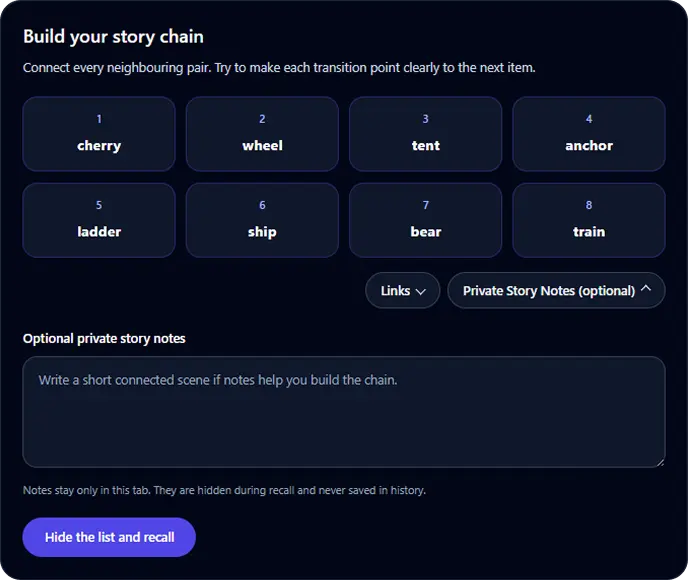
Goal: Recall a short ordered list through connected links
Build a connected story for 4 to 8 items, hide the list, recall it in order, identify the first broken link, and retest after focused repair.
Start Story Chain TrainerVisual Memory Test
Remember sequences or patterns
Memory • Focus • Levels
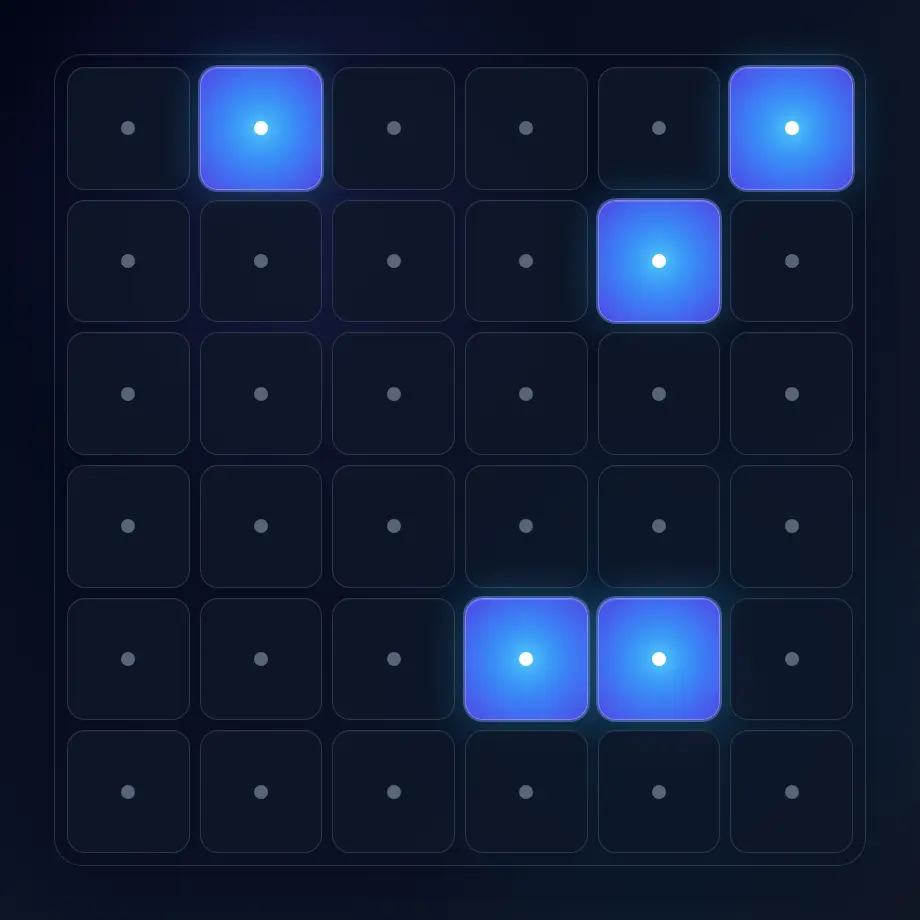
Goal: Better visual sequence and pattern recall
Choose ordered sequence or 3-second pattern recall, progress through levels, choose difficulty, track your best level, and compare recent local sessions.
Start Memory Test