

How to Remember a Shopping List: Group, Recall and Check
Last updated 7 minutes to read
To practise remembering a shopping list, write it first, organise it into meaningful groups, hide it and recall every item. Then check the details against the original. Keep the written list for the actual shop. Remembering nine things is not enough if one is the wrong thing or you buy the wrong quantity.
This guide works through a fictional nine-item grocery and household list. You will check item identity separately from quantity, repair a missing cue and handle a last-minute change. It is a practical exercise, not a memory assessment or a promise of wider cognitive improvement.
Start with what you actually need to buy
Make a single source list before creating any mnemonic. Replace vague entries such as “fruit” with the intended item. Add quantities and product details that matter. If someone else requested an item, clarify it instead of inventing the detail when you reach the shelf.
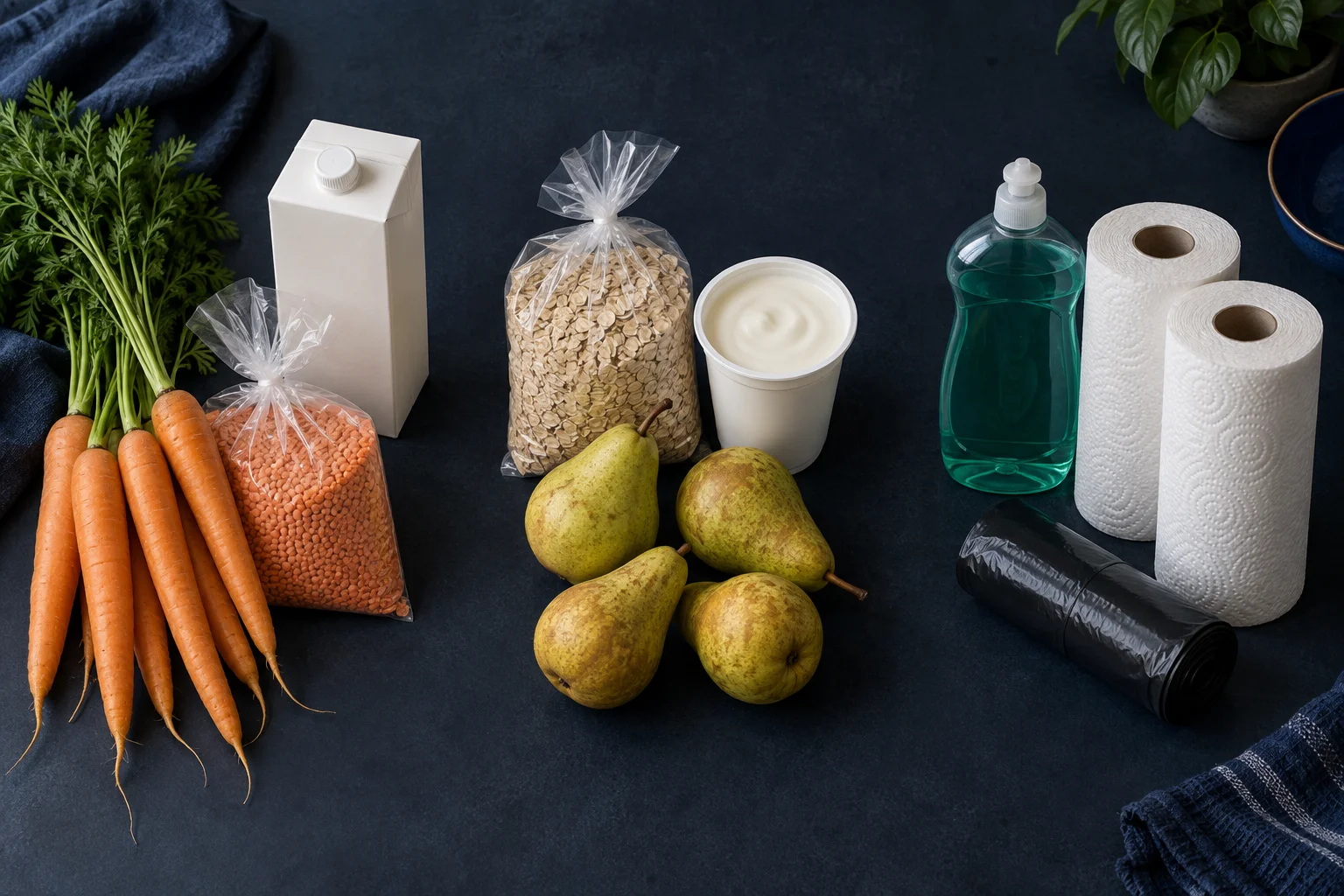
The example below is a made-up shopping trip, not a recipe or dietary recommendation. Soup and breakfast are useful headings because they describe the purpose of those items; household is a separate group. Your own headings might follow rooms, meals or familiar shop sections.
Soup
- Carrots: 1 kg
- Red lentils: 500 g
- Vegetable stock: 1 litre
Breakfast
- Oats: 1 bag
- Plain yogurt: 500 g
- Pears: 4
Household
- Washing-up liquid: 1 bottle
- Kitchen roll: 2 rolls
- Rubbish bags: 1 pack
There are three groups of three items. That count is a check for missing slots, not proof of correct recall: three breakfast items could still include the wrong fruit. Nine is simply the size of this example, not a recommended memory limit.
Use group names as starting points, not substitutes for items
Say the headings: soup, breakfast, household. Then expand each heading into its three exact items. If “soup” brings back only carrots, the heading has not done the whole job. Check the source and practise expanding that group again.
This is the everyday application of meaningful grouping, or chunking . You still need to recover each item inside a group. The longer technique guide explains how to choose groups; here the question is whether your groups reconstruct this particular shopping list.
Add a short link only where you need one
For the soup group, try an invented scene: a carrot scoops red lentils into a carton of vegetable stock. For breakfast, imagine oats falling onto a pot of plain yogurt, with pears balancing on top. Say the exact item names as you follow the scene.
These scenes link item identities; they do not encode all the quantities. Keep “1 kg”, “500 g” and “1 litre” attached to the written soup entries and check them separately. A memorable picture of a carton cannot tell you how much stock was requested.
You do not have to make images. A spoken phrase such as “soup: carrots, red lentils, vegetable stock” gives you a concrete sequence to test. If you prefer linked scenes, the Story Chain Memory Trainer offers a hide, recall and repair exercise. There is no need to build a palace for this small list; the mnemonics guide compares the alternatives.
Hide the source and check two things
On paper, note the three headings, then put the source list out of sight. Write or say the items and details from memory before looking back. This is a paper exercise; nothing you recall needs to be entered on this page.
- Item check: did you recover each of the nine requested items? Any order is acceptable. Count a repeated item once, and note any extra item separately.
- Detail check: for each recovered item, did you also remember the requested quantity and type? “Yogurt” alone does not fully recover “plain yogurt, 500 g”.
- Hint check: mark items recalled only after reopening the source as assisted. Do not quietly add them to the first unaided result.
A full-looking list can still be wrong
Suppose you recall everything except vegetable stock, add oranges that were not requested and say “2 pears” instead of “4 pears”. Assume every other detail is correct. You have written nine entries, but only 8 of 9 requested item identities and 7 of 9 complete item-and-detail lines . Oranges are one extra, not a replacement point for stock.
The useful next action is specific: repair the missing stock link, correct the pear quantity and remove the extra oranges. Repeating only the total “nine” would not address any of those errors.
A small record you can copy
Use this on paper if you want to distinguish an initial attempt from a corrected one:
- List/version and group names: ______
- First recall: ___ / 9 items; ___ / 9 complete lines; extras: ______
- What needed a hint or correction: ______
- Changed cue or detail: ______
- Later check, before looking: ______
This is a private practice note, not a feature saved by the website. For your own list, replace nine with its actual number of distinct entries.
Repair the weak part and keep one current version
- A whole group disappears: practise the three headings first, then expand them. Before checkout, use the written list to check all groups, including those whose shelves you did not visit.
- You remember the scene but not the item: make the intended object explicit. A generic container is not necessarily vegetable stock. Rebuild that link, hide the source and test the group again.
- The quantity is wrong: correct the item-and-quantity pair. Do not redesign every scene when the missing information is simply “4 pears”.
- An old item intrudes: compare with today's source rather than treating familiarity as proof that it belongs. Remove the old item from the current note and cue.
What if the list changes before you leave?
For example, someone now asks for four apples instead of four pears. Update the written breakfast entry first. Replace pears with apples in that scene, then hide the list and recall all three breakfast items with their details. The group still contains three items, but its content has changed. Finally, check the full current list, not just the edited line.
At the shop, use the source list to record what you have picked up. Knowing that an item is needed is different from knowing that it is already in the basket. If a product is unavailable, note an agreed substitution rather than silently changing the memory target. Keep exact product requirements written down.
Choose practice that matches the job
For this shopping task, complete and accurate recall matters more than speed or order. Try recalling the same list again after doing something else, before checking the source. A corrected same-sitting attempt and a later unaided attempt answer different questions; neither establishes a general memory score.
For a separate grouping exercise, choose nine items in the Chunking Memory Trainer . It checks exact positions, unlike the any-order item check above. To practise these nine item names, enter them as a custom list in the fixed order soup, breakfast, household. Product quantities and real shopping completion still need their own checks; the trainer is not a shopping-list app.
Use the Story Chain trainer when you want to practise whether one item actually cues the next. Both tool results describe their own task rules, so do not compare their percentages directly with this paper check. The progress-comparison guide explains why matching conditions matter.
If you need to remember actions in a required order rather than items to buy, use the separate process and sequence guide . For today's shopping, the finish line is simpler: check the current written list against the basket. Keeping that backup is part of the method, not a failure of it.
Questions about remembering a shopping list
Written backups, item order and keeping the current list separate.
Should I stop writing shopping lists?
No. Keep an up-to-date written list and use recall as an extra check. A mnemonic does not reliably record quantities, agreed substitutions or whether you have already put something in the basket.
Do I need to remember groceries in order?
For this exercise, no: check that every requested item and detail is present, in any order. A story or grouped order can provide a route through the list, but the order is a cue, not the shopping goal. Some browser trainers score exact positions, which is a different rule.
What if I remember yesterday's list instead?
Start from today's written source, identify what changed and replace the affected cue. Hide the source and recall the changed group again, then check the complete list. Keep the old list separate rather than relying on a familiar image to tell you which version is current.
Continue learning
More Quartenson guides connected to this topic.
Chunking for Memory
Learn how to turn digits, concepts, and instructions into meaningful chunks, then test exact recall, diagnose errors, and choose when another mnemonic works better.
Practical Guide to Mnemonics
Learn how mnemonic devices work and when to use chunking, chaining, memory palaces, peg systems, acronyms, and more, with step-by-step examples.
Remember Important Meeting Details
Remember meeting decisions, reasons and follow-ups with a six-field note template, a worked example and a recall check that catches mixed-up owners and deadlines.
Remember What You Learn With AI
Turn an AI explanation into knowledge you can use: choose what to learn, check the source, recall the rule and test its exceptions with a worked example.
Try a free tool
Practice the same ideas with a browser-based exercise.
Chunking Memory Trainer
Group, recall, and reconstruct
Meaningful groups • Exact order • Repair
Meaningful groups
- 1apple
- 2pear
- 3plum
- 4ticket
- 5map
- 6train
Chunking Memory Trainer
Browser toolGoal: Recall an ordered list through meaningful groups
Practise 6, 9, or 12 words, digits, or private custom items. Build useful groups, hide the list, reconstruct every position, compare chunks, and repair weak groups.
Start Chunking TrainerStory Chain Memory Trainer
Link items into one connected story
Build • Recall • Repair
Story Chain Memory Trainer
Browser toolGoal: Recall a short ordered list through connected links
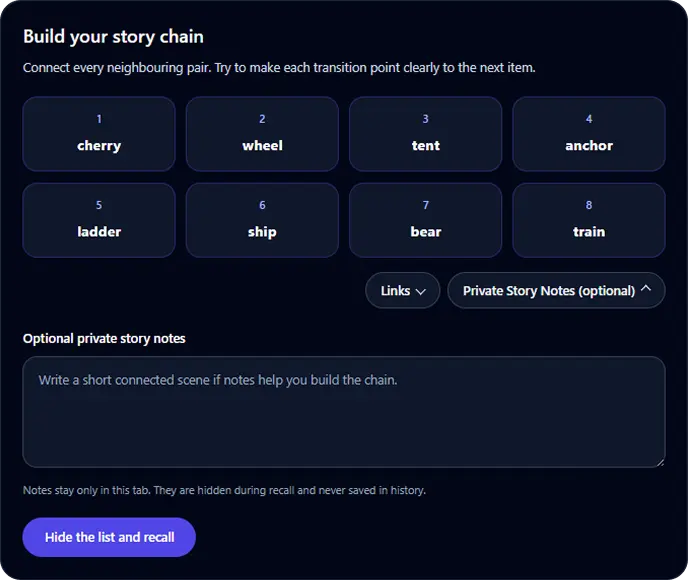
Build a connected story for 4 to 8 items, hide the list, recall it in order, identify the first broken link, and retest after focused repair.
Start Story Chain Trainer