Chunking for Memory: How to Group Information and Recall It Accurately
Last updated 17 minutes to read
Chunking is often described as putting information into smaller groups. That is only the visible part. A useful chunk is a familiar or meaningful unit that lets one cue recover several connected details. Spaces, colors, or pauses can mark boundaries, but boundaries alone do not create knowledge.
The quality check is reconstruction. If the label "inputs" helps you retrieve light, water, and carbon dioxide in the required form, the group is doing useful work. If you remember only the label, the details were hidden rather than learned. This guide shows how to build, test, and repair chunks without promising a universal capacity number.
What is chunking in memory?
Chunking lets you handle several details as one learned pattern by using a relationship or structure you can retrieve as a unit. Instead of maintaining every element as unrelated, you organize connected information around prior knowledge, meaning, or a stable sequence.
For example, 2 0 2 6 can be four unrelated digits or the familiar year 2026. The second representation is useful only if the chunk still lets you recover 2, 0, 2, and 6 in the right order when exact recall matters.
Input
Separate details that currently compete for attention
Transformation
A familiar pattern, meaningful relation, or learned sequence
Quality test
The chunk cue reconstructs every required detail accurately
Grouping is not always the same as forming a meaningful chunk
Visual spacing, rhythm, color, and pauses can split a long sequence into manageable sections. Research on immediate ordered recall shows that boundaries themselves can help people recover nearby items. That is useful perceptual grouping, even when the groups have no meaning beyond their presentation.
A stronger chunk also draws on a recognizable unit in long-term memory. A familiar acronym, date, phrase, category, or learned action sequence can stand in for its components during recall. Repeated exposure can gradually form such a representation, but a colored box does not instantly turn arbitrary material into one durable chunk.
Boundary only
418 572 936
Spacing creates three rehearsal groups. It may help ordered recall, but 418 has no built-in meaning unless you already know it as a unit.
Meaningful structure
2026 | 08 | 12 | 14:30
The groups can represent an appointment: year, month, day, and time. The labels provide structure, and each group still preserves exact values.
Three questions that expose a real chunk
- Can you name the relationship that holds the elements together?
- Does the group cue recover its members without rereading them?
- Can you reconstruct the required order, wording, or values rather than only the gist?
Sources: Memory & Cognition via PubMed; Cognition via PubMed.
How many items can a person remember with chunking?
There is no responsible universal answer such as "seven items" or "four chunks of any size." Immediate-memory performance changes with the material, presentation rate, similarity, prior knowledge, rehearsal, attention, and what counts as a correct answer. A four-digit year is not equivalent to four unfamiliar symbols, and recalling the gist is not equivalent to reproducing every item in order.
Early work connected memory span with recoding and helped popularize seven plus or minus two, but later reviews caution against using that figure as a general design law or a fixed personal limit. Analyses often identify a smaller central capacity when rehearsal and long-term-memory support are controlled. Even that estimate is task-dependent, not a promise that any four arbitrarily large chunks will fit.
Modern experiments support a narrower claim: familiar chunks can reduce working-memory load, but the benefit is not independent of chunk size or overlap. If two chunks share elements, or a label does not reliably unpack into its members, the apparent compression can fail.
Capacity depends on
- How familiar and distinctive each chunk is
- How many elements must be unpacked from it
- Whether chunks overlap or compete
- Whether order and exact wording matter
- How much attention, rehearsal, and prior knowledge are available
- Whether recall is immediate or delayed
Sources: Behavioral and Brain Sciences via PubMed; Journal of Experimental Psychology via PubMed.
A practical chunking workflow
Use this sequence for numbers, terminology, an outline, or a short low-risk procedure. The method begins with the retrieval goal, not with drawing boxes around equal numbers of items.
- 1Define the required output: Decide whether you need the gist, every item, the original order, exact spelling, or exact digits. You cannot test chunk quality until success is defined.
- 2List the atomic details: Write the smallest elements that must survive. Keep the source visible at this stage so you do not silently omit or rewrite information.
- 3Find a real relationship: Group by category, cause, phase, location, familiar pattern, or another relation that exists in the material. If the only rule is "three things per box," call it spacing rather than meaning.
- 4Give each chunk a precise cue: Choose a short label or prompt that distinguishes the group and predicts what belongs inside it. Avoid broad labels such as "miscellaneous."
- 5Encode the internal structure: Notice order, roles, and boundaries inside the group. Say why each member belongs and what separates it from neighboring chunks.
- 6Hide the source and reconstruct: Use the cue to produce every required member. Then compare with the source, mark omissions, substitutions, intrusions, and order errors, and repair only the weak group.
- 7Retest after a delay: A chunk that works immediately may still be fragile. Retrieve it later and in a different order when flexible access matters.
Three complete chunking examples
These examples show the whole path from raw information to a retrieval test. The labels are not the final answer. Each label must unpack into the original details.
Example 1: reconstruct an exact digit sequence
Raw sequence
2 0 2 6 0 8 1 2 1 4 3 0
Structured representation
2026 | 08 | 12 | 14:30
Meaning
An appointment on 12 August 2026 at 14:30, written back in year-month-day-time order.
- Name the four roles: year, month, day, time.
- Cover the original and retrieve the appointment in ordinary language.
- Convert it back to 2026 08 12 14 30.
- Compare all twelve digits and the order with the source.
This only works if the date meaning is clear to you. If 2026, 08, 12, and 14:30 remain arbitrary strings, the bars provide grouping boundaries but little semantic compression.
Example 2: organize concepts by their role
Suppose a basic photosynthesis outline contains: light, water, carbon dioxide, chloroplast, chlorophyll, glucose, and oxygen. First understand the topic, then group the terms by relationships in your source.
| Chunk cue | Members | Retrieval question |
|---|---|---|
| Inputs | light, water, carbon dioxide | What does the outline say the process uses? |
| Site and capture | chloroplast, chlorophyll | Where is the process represented, and what captures light? |
| Outputs | glucose, oxygen | What does the outline list as products? |
Close the table. Produce all three cues, unpack all seven terms, and explain each relationship in your own words. Then verify against the learning source. If you can name "inputs" but omit water, the cue survived and the inside of that chunk needs repair.
Example 3: group a low-risk procedure by phase
Consider a generic software-update practice checklist. The original six steps are: save current work, create a backup, install the update, restart the application, test the main workflow, record the result.
| Phase cue | Exact steps | Boundary check |
|---|---|---|
| Prepare | 1. Save current work. 2. Create a backup. | Both happen before changing the software. |
| Change | 3. Install the update. 4. Restart the application. | Installation precedes restart. |
| Verify | 5. Test the main workflow. 6. Record the result. | Testing produces the result you record. |
Retrieve Prepare -> Change -> Verify, then expand each phase into its two actions in order. Finally, compare all six steps with the written checklist.
Retrieval must unpack the chunk
Recognition can create false confidence. A grouped page looks clear because the labels and members are still visible. Close it, show only a cue, and generate the members before checking. That separates a usable retrieval structure from attractive formatting.
Score at the level your task requires. For a phone number, one wrong digit is wrong. For a conceptual outline, you may need every term plus an accurate explanation. For an ordered procedure, include both membership and sequence. Do not award full credit for the label when its contents are missing.
Record errors precisely
- Omission: a required member is missing
- Substitution: the wrong member replaces the correct one
- Intrusion: an item from another chunk appears
- Order error: members are present but misplaced
- Cue failure: the chunk label itself cannot be retrieved
- Explanation failure: terms return, but their relationship cannot be explained
A better testing loop
- Attempt from the cue before revealing anything.
- Compare with the authoritative source, not with a feeling of familiarity.
- Correct the answer immediately and state why the missed item belongs.
- Retest the weak chunk from a clean prompt.
- Test again later instead of repeating only while the answer is still active.
Source: Science.
Diagnose the error before rebuilding every chunk
A miss can occur at the cue, boundary, internal order, or meaning. Match the repair to the failure instead of making every group more elaborate.
| What happens | Likely problem | Targeted repair |
|---|---|---|
| You remember the label but not its members | The label was learned separately from the details | Practise cue-to-members retrieval and explain why each member belongs. |
| An item moves between groups | The boundary or category rule is ambiguous | State one inclusion rule and one contrast with the neighboring chunk. |
| All items return, but the order is wrong | Membership was encoded without internal sequence | Add numbered roles, a causal path, or first-next-last prompts inside the chunk. |
| A large chunk collapses halfway through | The cue is expected to unpack too many weakly connected elements | Split it at a natural substructure and test both smaller groups. |
| Two chunks produce the same answers | The sets overlap without distinctive cues | Clarify context, use narrower labels, or test shared members from both directions. |
| The grouping works now but not tomorrow | Immediate rehearsal was mistaken for durable learning | Use delayed retrieval and rebuild only the association that disappeared. |
| You can recite terms but cannot explain them | Chunking preserved labels without understanding | Return to the source, explain relationships, and test application with a new example. |
When chunking is useful, and when it is not
Chunking is strongest when the material contains a real structure that matches the future retrieval task. It is weaker when grouping hides uncertainty, exact details, or safety requirements.
Good uses
- Long numbers with familiar subunits such as dates, codes, or known prefixes
- Terminology that belongs to clear categories or functional roles
- A study outline with a small number of meaningful sections
- A familiar sequence that can be practised as stable phases
- Breaking a complex task into subgoals while preserving the steps inside each one
Use another support when
- The groups are arbitrary and have no cue beyond their visual boxes
- You do not yet understand why the concepts belong together
- Exact wording matters and paraphrasing would change the answer
- Several groups overlap so heavily that their labels create confusion
- A written reference or checklist is safer and easier to verify
- The material is a short ordered list better served by a story, pegs, or locations
Chunking compared with Story Chains, Peg Systems, and Memory Palaces
These methods solve different retrieval problems. They can be combined, but adding a mnemonic layer is useful only when it preserves the answer and makes the desired cue easier to use.
| Retrieval need | Usually start with | Why |
|---|---|---|
| Compress familiar patterns or organize concepts by meaning | Chunking | The material itself provides categories, phases, or learned units. |
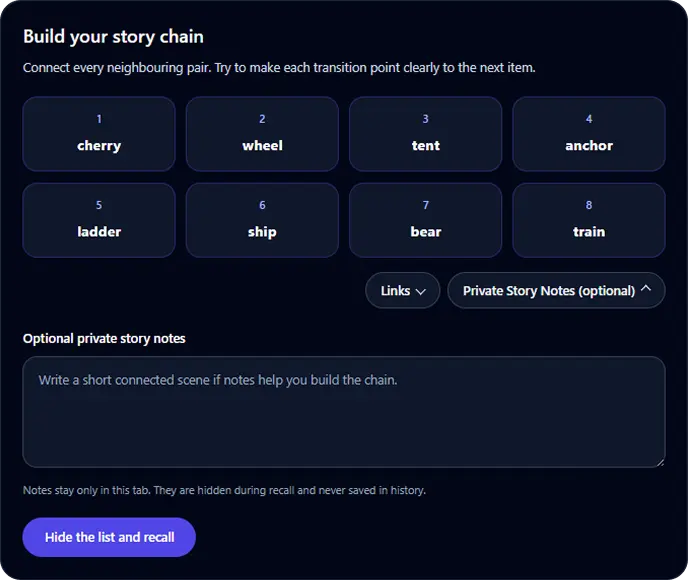
| Recall a short list in one connected order | Story Chain | Each item cues the next through one continuous scene. |
| Retrieve a short item directly from its numbered position | Peg System | A permanent numbered cue gives each target an address. |
| Place many items along a familiar spatial route | Memory Palace | Distinct locations organize ordered information and sections. |
Chunking can work inside every other method. One palace location might hold a meaningful category, or one peg might cue a small structured set. Test the members separately so the higher-level cue does not conceal gaps.
Explore the practical Story Chain Memory Trainer, read the Peg System guide, or compare more techniques in the complete mnemonics guide.
What the evidence supports, and what it does not
Laboratory studies support several parts of the practical model. Presentation boundaries can improve immediate ordered recall. Familiar chunk representations can reduce working-memory load. Recognizable repeated sequences can develop into long-term chunks when their structure is noticed.
The evidence does not justify treating chunking as unlimited storage. Benefits depend on prior knowledge, chunk size, overlap, task demands, and whether the representation can be unpacked. A strategy can be powerful for material with a learned structure without showing a general ability to group anything.
Sources: Memory & Cognition via PubMed; Journal of Experimental Psychology via PubMed; Cognition via PubMed.
A focused first chunking session
Use one short, low-risk set that you can verify. Stop adding material when the current chunks no longer unpack accurately.
2 minutes
Choose 8-12 details and write what exact output you need.
3 minutes
Find two to four real categories, phases, or familiar patterns and label them precisely.
3 minutes
Explain why each member belongs and note any required internal order.
3 minutes
Hide the source, retrieve every group, and reconstruct all original details.
2 minutes
Classify each error and repair only the weak cue, boundary, or internal sequence.
Later
Retest from clean prompts after a delay and verify against the source again.
A good session ends with verified reconstruction, not with the largest possible groups. Smaller accurate chunks are more useful than impressive labels that cannot recover their contents.
Choose the mnemonic that matches the retrieval task
Use chunking for meaningful groups, a Story Chain for a connected sequence, and pegs for direct numbered access. The broader guide explains how to choose and combine these methods without losing the original information.
Sources and further reading
The practical recommendations above distinguish immediate grouping, meaningful long-term chunks, working-memory limits, and retrieval practice. These primary papers and authoritative records provide the research basis.
- The Magical Number 4 in Short-Term Memory: A Reconsideration of Mental Storage Capacity - Behavioral and Brain Sciences via PubMed.
- Explanations of Grouping in Immediate Ordered Recall - Memory & Cognition via PubMed.
- How Does Chunking Help Working Memory? - Journal of Experimental Psychology via PubMed.
- Grouping in Working Memory Guides Chunk Formation in Long-Term Memory: Evidence from the Hebb Effect - Cognition via PubMed.
- The Critical Importance of Retrieval for Learning - Science.
Frequently Asked Questions
Short answers that clarify the main value of this article.
What is chunking in memory?
Chunking lets you handle several details as one familiar or meaningful pattern. A useful chunk reduces the number of separate elements you must manage while still letting you reconstruct the required details.
What is a simple example of chunking?
The digits 2 0 2 6 can be treated as four separate digits or as the familiar year 2026. The year is a useful chunk if it helps you recover all four digits in the correct order.
Is putting spaces in a number the same as chunking?
Spacing creates boundaries and can help immediate ordered recall, but it does not necessarily create a meaningful long-term chunk. The groups become stronger when they are familiar, repeated, or connected to a precise meaning.
Does working memory hold seven chunks?
There is no universal seven-chunk rule. Performance depends on the material, task, prior knowledge, rehearsal, chunk size, overlap, and scoring. Seven plus or minus two should not be treated as a fixed personal capacity or design law.
How large should one chunk be?
Use the smallest unit that expresses a real pattern and still unpacks accurately. If you omit or reorder members, split the group at a natural boundary. There is no best size that works for every task.
Can chunking help with studying?
Yes, when you already understand the material and group concepts by a real relationship such as role, cause, phase, or category. Test every member and explanation, because remembering a heading alone is not enough.
How do I test whether a chunk works?
Hide the source, show only the chunk cue, reconstruct every required detail, and compare with the source. Record omissions, substitutions, intrusions, order errors, and explanation failures separately.
Why can I remember the category but not the items inside it?
The category label has become familiar, but the cue-to-members path is weak. Practise unpacking the label, explain why each member belongs, correct omissions, and retest after a delay.
Is chunking better than a Story Chain or Peg System?
Not universally. Chunking suits meaningful groups, Story Chains suit short connected sequences, and Peg Systems suit direct numbered retrieval. Choose the method that matches the cue you will receive later.
Can chunking replace a written checklist?
No for high-stakes procedures. Use written, approved checklists for medication, safety, emergencies, legal requirements, and other tasks where an omitted or reordered step can cause harm.
Does chunking improve general memory?
Chunking can improve performance for material that matches learned structures and strategies. Evidence does not show that organizing one kind of material guarantees a broad or permanent increase in general memory capacity.