How to Improve Visual Memory: Pattern, Sequence, and a 14-Day Practice Plan
Last updated 10 minutes to read
Visual-memory practice becomes more useful when you define the task, keep the settings stable, and compare several sessions instead of chasing one unusually high level. A pattern shown all at once is not the same challenge as a route shown one cell at a time, so the two results should not be treated as one universal memory score.
This guide gives you a repeatable way to practise both formats. It focuses on task performance, strategy, accuracy, and personal trends. It does not turn a recreational browser exercise into a clinical memory assessment.
How can you improve visual-memory task performance?
Start with a baseline in one mode and difficulty, then repeat short sessions under the same conditions. Use grouping for simultaneous patterns and short ordered chunks or routes for sequences. Review accuracy, mistakes, and typical level together rather than judging progress from one personal best.
Early improvement may reflect familiarity, attention, or a better strategy. That is still useful task learning, but it is not evidence that every kind of memory has changed.
Keep comparable
Mode, difficulty, device, and session length
Review together
Typical level, accuracy, mistakes, and consistency
Change slowly
Practise one strategy before adding another
Visual memory is not one single system
Visual memory is a broad label for retaining and accessing visual information across different timescales. Researchers commonly distinguish very brief visual storage, limited visual working memory used during an active task, and visual long-term memory. A short grid exercise mainly places demands on brief visual-spatial maintenance, attention, response rules, and the strategy used to encode the display.
That is why a result from one browser task should describe performance in that task. It should not be converted into a clinical conclusion, an IQ estimate, or a permanent label such as good or bad memory.
Sources: Open Encyclopedia of Cognitive Science .
Pattern memory and sequence memory ask different questions
Quartenson includes both formats so you can practise two related but non-equivalent demands.
| Mode | What you remember | Main pressure | Strategy to try |
|---|---|---|---|
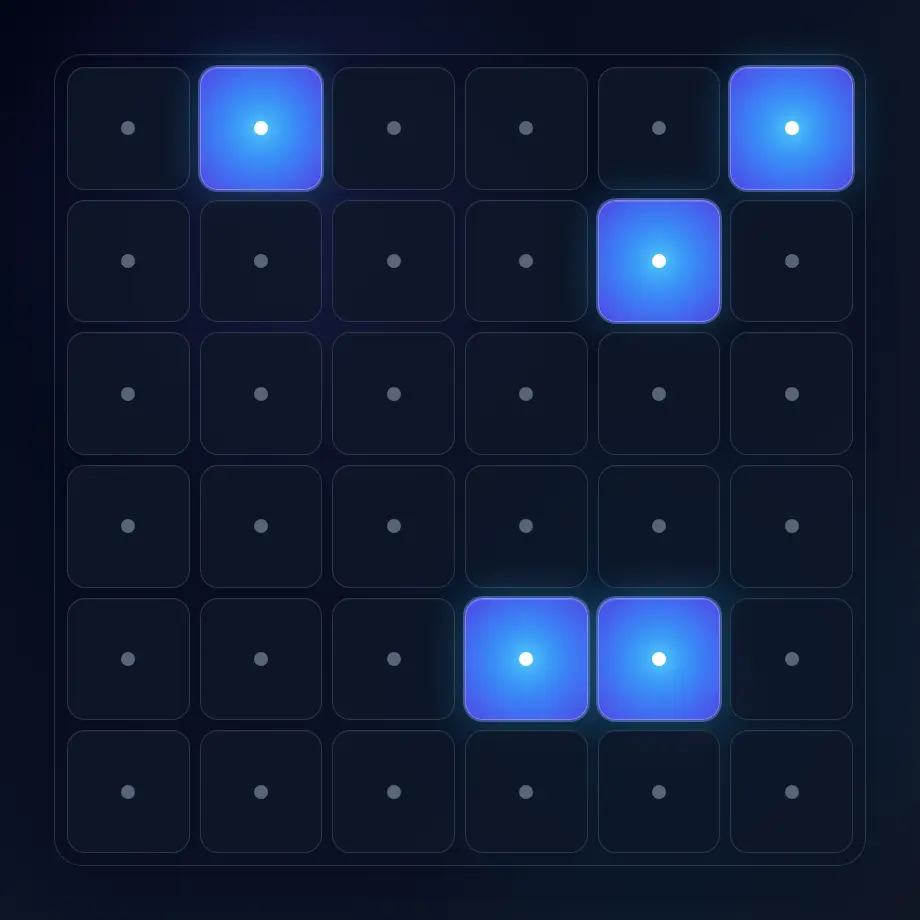
| Pattern | Several highlighted locations shown together for three seconds. | Covering the whole grid while retaining spatial relationships. | Group nearby cells into shapes, regions, or a simple spatial description. |
| Sequence | Highlighted locations shown one after another in a specific order. | Retaining both location and order as the sequence grows. | Use short ordered chunks, rhythm, or an imagined route through the grid. |
Do not compare Pattern level 8 directly with Sequence level 8. Even when the grid looks similar, presentation, timing, response requirements, and useful strategies differ.
Take a repeatable two-mode baseline
A baseline is a starting snapshot, not a permanent rating. Use this simple protocol before beginning the plan.
- Open the Visual Memory Test and choose Standard difficulty.
- Complete one familiarisation attempt in Pattern mode. Do not count it if you were still learning the controls.
- Complete three Pattern sessions, taking a short pause between attempts.
- Repeat the same process in Sequence mode.
- For each mode, note the middle or typical completed level, accuracy, mistakes, and longest sequence where available.
- Keep the same device, input method, difficulty, and general environment for the final comparison on day 14.
Stop if fatigue or frustration makes the attempts careless. More attempts are not automatically better data.
Take the free visual memory testFive strategies worth testing
Treat each strategy as an experiment. Use one long enough to see whether it helps accuracy and repeatability rather than switching techniques after every mistake.
1. Spatial grouping
Instead of storing isolated cells, look for a small shape: an L, a diagonal, a corner pair, or two clusters. Grouping can reduce the number of separate descriptions you try to maintain.
2. Divide the grid
Mentally split the board into top and bottom, left and right, or four quadrants. Encode which region contains each part before focusing on exact positions.
3. Use short sequence chunks
For ordered cells, rehearse two or three steps as a small unit. A consistent rhythm can help preserve boundaries between chunks.
4. Imagine a route
Translate a sequence into movement: up, across, centre, down. The route should support the actual order rather than replace it with a vague picture.
5. Review the error type
Ask whether you lost a location, reversed the order, clicked too quickly, or misread the grid. Different errors call for different adjustments.
Research on visual working memory supports a nuanced view of chunking: grouping related information can improve effective storage, but it can also trade precision for broader coverage. Other training research suggests that performance gains can coincide with a switch to a more efficient strategy. These findings support testing strategies; they do not prove that a game expands a fixed general memory capacity.
Sources: Psychological Review / PubMed; PubMed .
A practical 14-day visual-memory plan
Keep each session short: about three measured attempts or five to ten minutes. The plan is intentionally light so that attention remains usable and comparisons stay interpretable.
| Day | Practice |
|---|---|
| Day 1 | Complete the two-mode baseline. Record Pattern and Sequence separately. |
| Day 2 | Repeat Pattern on Standard. Practise spatial grouping without chasing speed. |
| Day 3 | Repeat Sequence on Standard. Try chunks of two or three locations. |
| Day 4 | Practise Pattern and divide the grid into consistent regions. |
| Day 5 | Practise Sequence and describe the route through the grid. |
| Day 6 | Use one light session in the mode that currently feels less consistent. |
| Day 7 | Rest, or complete one relaxed attempt without treating it as a benchmark. |
| Day 8 | Repeat the day-2 Pattern setup and compare typical accuracy. |
| Day 9 | Repeat the day-3 Sequence setup and review order errors. |
| Day 10 | Use the Visual Search Test for a short change of task, not as a memory score. |
| Day 11 | Alternate one Pattern attempt and one Sequence attempt. |
| Day 12 | Practise the weaker mode while preserving the original settings. |
| Day 13 | Rest or take one low-pressure familiarisation attempt. |
| Day 14 | Repeat the day-1 baseline protocol and compare like with like. |
If you continue after two weeks, change only one variable at a time. Moving to Hard difficulty creates a new baseline rather than extending the old one unchanged.
How to tell whether performance is changing
Use several signals together. A cleaner trend matters more than a dramatic isolated attempt.
- Typical completed level: compare the middle of several similar sessions, not only the maximum.
- Accuracy: check whether higher levels are still being completed cleanly.
- Mistakes: fewer avoidable errors can be progress even before the best level changes.
- Longest sequence: compare this only within the same Sequence difficulty.
- Consistency: look for a narrower gap between weaker and stronger sessions.
- Conditions: note large changes in device, input method, interruptions, or session timing.
For a broader measurement framework, use the Quartenson guide to benchmarking cognitive training progress. It explains why medians, accuracy, consistency, and matched settings are more informative than one best result.
What research can - and cannot - support
A large meta-analytic review found improvement on trained tasks and closely related working-memory measures, while far transfer to intelligence, verbal ability, reading, or arithmetic was not reliable in comparisons with treated control groups.
For this guide, the defensible goal is therefore narrower: practise the selected visual-memory task, learn strategies, and observe whether performance becomes cleaner or more consistent under matched conditions. Better game results should not be advertised as proof of a broad cognitive upgrade.
Sources: Perspectives on Psychological Science / PMC .
Visual exercises and mnemonics solve different problems
A grid exercise asks you to retain brief locations or an ordered route. A mnemonic technique helps encode meaningful information so it can be retrieved later. The method of loci, often called a memory palace, places memorable images along a familiar route. It is better suited to material such as a list, speech outline, or ordered concepts than to claiming a higher score in every kind of memory task.
A 2025 systematic review and meta-analysis supports the method of loci for immediate serial recall in adults, while rating the available evidence as low to very low quality. This is the direction planned for the future Quartenson Memory Trainer: memory exercises, longer-term history and analytics, and practical mnemonic instruction presented with clear boundaries around what each activity measures.
Start with a baseline you can repeat
Open the free Visual Memory Test, keep Standard difficulty unchanged, and complete the Pattern and Sequence baseline. Your recent sessions and personal bests stay in this browser for local progress review.
Sources and further reading
These sources support the distinctions and qualified research summaries in this guide. They do not turn the Quartenson browser exercise into a clinical assessment.
- Visual Memory - Open Encyclopedia of Cognitive Science.
- Chunking as a rational strategy for lossy data compression in visual working memory - Psychological Review / PubMed.
- Training-induced improvement in working memory tasks results from switching to efficient strategies - PubMed.
- Working Memory Training Does Not Improve Performance on Measures of Intelligence or Other Measures of Far Transfer - Perspectives on Psychological Science / PMC.
- The method of loci in the context of psychological research: A systematic review and meta-analysis - British Journal of Psychology / PubMed.
Frequently Asked Questions
Short answers that clarify the main value of this article.
Can visual memory be improved with practice?
Practice can improve performance on the trained visual-memory task and may help you adopt more efficient strategies. Research is less consistent about broad transfer to unrelated abilities, so improvement should be described in terms of the task and conditions you actually repeated.
What is a good visual memory level?
There is no universal level that applies across different websites, modes, timings, grids, and scoring rules. Compare several sessions from the same Quartenson mode and difficulty, using accuracy and mistakes alongside completed level.
Should Pattern and Sequence results be compared directly?
No. Pattern mode shows several locations together, while Sequence mode requires both locations and order. Keep separate baselines and histories for each mode and difficulty.
Is the Visual Memory Test a medical or clinical assessment?
No. It is a recreational browser exercise for practice and personal comparison. It cannot diagnose a memory, attention, learning, or health condition.
How long should a visual-memory practice session be?
A short session of about three measured attempts or five to ten minutes is enough for this plan. Stop when fatigue or frustration begins to make attempts careless, because extra noisy sessions are not automatically useful practice data.