

How to Measure Focus: A Practical Work and Study Log
Last updated 7 minutes to read
How can you measure focus in everyday work?
Choose one task, define what a correct result looks like, and record what you completed, what needed correction, and when you left the task. Compare several similar sessions before changing your routine. This measures how the task went, not a universal focus level. You can start with paper and a timer; a game score or a practice streak is not required.
Start with a task you actually want to do better
Replace ‘I want better focus’ with something you can check: ‘I want to review a short document without missing its requirements.’ For studying, that might mean answering three questions correctly after reading. For writing, it might mean producing one paragraph that meets a brief. Pick one kind of work rather than combining everything into a score.
Keep your impression, too: ‘This felt difficult’ is useful context. Pair it with the result. A demanding session can produce accurate work, while an easy-feeling session can leave important errors. Time at a desk and days practised describe your routine; they do not establish how well you attended to the task.
Try one short work block
Use a manageable block, such as 10 minutes, for your first record. Ten minutes is a convenient example, not a recommended attention span or a validated test duration.
- Before starting, write one task and its finish rule. For example: check an announcement against five facts, keeping the source available. Decide how you will check quality before seeing the result.
- Keep the time limit, task type and checking rule the same for later comparisons. Note meaningful differences such as a harder text, another device or an unusually noisy setting.
- During the block, make a small tally when you notice an unrelated switch, such as opening a message that is not needed for the task. Keep required research and unavoidable interruptions separate. Do not try to count every wandering thought.
- If interrupted, leave a short return note: ‘Next: check the room number.’ Resume from it. If tallying itself disrupts the work, make a rough note afterward and label it an estimate.
- At the end, keep the time spent, including interruptions, and note unfinished work. Check the output against the finish rule. Record remaining errors as well as completion; do not extend the block just to obtain a better result.
A one-line log to keep in your own notes
Date / task and finish rule / time limit and time spent / checked result / corrections still needed / unrelated switches / context / next change
Use a short task label, not confidential work content. No log is entered or saved on this page. A partial session is still useful information; keep it instead of recording only good days.
Which measurements are worth keeping?
Start with checked output and one obstacle you want to understand. Add another field only if it helps you choose a next step.
| Record | Useful interpretation | Limit |
|---|---|---|
| Checked output | How much met the rule you chose | An easier task can produce more output |
| Errors or rework | Which requirements still need attention | An error can also reflect missing knowledge or unclear instructions |
| Time spent | What the task cost in elapsed time | Less time is not better if quality falls |
| Unrelated switches | A specific interruption pattern to investigate | A tally misses unnoticed drift; necessary switches are not failures |
| Sessions attempted | How often you made room for the task | A streak is not a measure of concentration |
Try it now: check a short announcement
This original fictional exercise makes the quality check concrete. It is not a standardized concentration test. Keep the brief visible; this is a checking task, not a memory test.
Source brief
The workshop is on Thursday in Room B. It starts at 14:00, has 12 places, and the contact person is Mira.
Announcement to check
Join our Tuesday workshop in Room A at 14:00. There are 120 places. Contact Mira for details.
Check the day, room, time, number of places and contact. Write the corrections before opening the answer. You may note your time, but the main result is whether all five facts are correct after your edits.
Show the corrections and check your result
- Change Tuesday to Thursday, Room A to Room B, and 120 places to 12 places.
- Keep 14:00 and Mira unchanged. There are three mismatches across five checked facts. Count any incorrect changes you introduced as errors, too.
If you missed a detail, compare one field at a time and repair it. Then try a different short brief using the same five-field check. Repeating this exact announcement tests familiarity with its answer, so it is not a fresh comparison. A miss here does not identify its cause or diagnose a focus problem.
Read a week's log without inventing a trend
Imagine three 10-minute blocks checking new announcements against five facts each. These fictional records illustrate interpretation, not expected progress or research results.
| Session | Facts correct after checking | Unrelated switches | Context |
|---|---|---|---|
| Monday | 4 of 5 | 3 | Notifications on |
| Tuesday | 5 of 5 | 1 | Notifications off |
| Thursday | 3 of 5 | 0 | Notifications off; denser brief |
Tuesday is a promising result to investigate. Thursday shows why fewer switches alone do not establish better work: more facts remained wrong. Check whether the denser brief was harder to interpret. These three sessions do not show that notifications caused the difference, and they are too few to establish a dependable trend.
Compare fresh tasks of similar difficulty and keep the quality rule unchanged. Do not average different task types, count an unfinished task as error-free, or hide sessions that went badly.
Turn a difficult session into a specific adjustment
Faster, but with more mistakes
Restore the checking step before chasing speed. For the announcement, compare each of the five fields against the brief instead of rereading the whole sentence quickly.
Few switches, little useful output
Check whether the task was clear and whether you had the needed information. Turn ‘work on the report’ into one deliverable, such as checking its three dates. Staying on one screen does not show that the work is progressing.
Repeated unrelated switches
Choose one removable trigger, such as message previews. Test the change during comparable blocks. Necessary communication still belongs in your schedule; a zero-switch target is not always appropriate.
Losing your place after interruptions
Write the next action before switching away. On return, check the last completed step rather than guessing where you stopped. Track whether you can resume the task, not whether you can avoid every interruption.
A bad result becomes a judgment about yourself
Describe the missed requirement and the session conditions. Avoid labels such as ‘poor focus’ from a single result. This log cannot diagnose an attention disorder or explain persistent difficulties.
Use browser exercises as a separate practice record
If you enjoy a repeatable browser task, choose one of these. Its results describe that exercise; assess work or study outcomes in your work log separately.
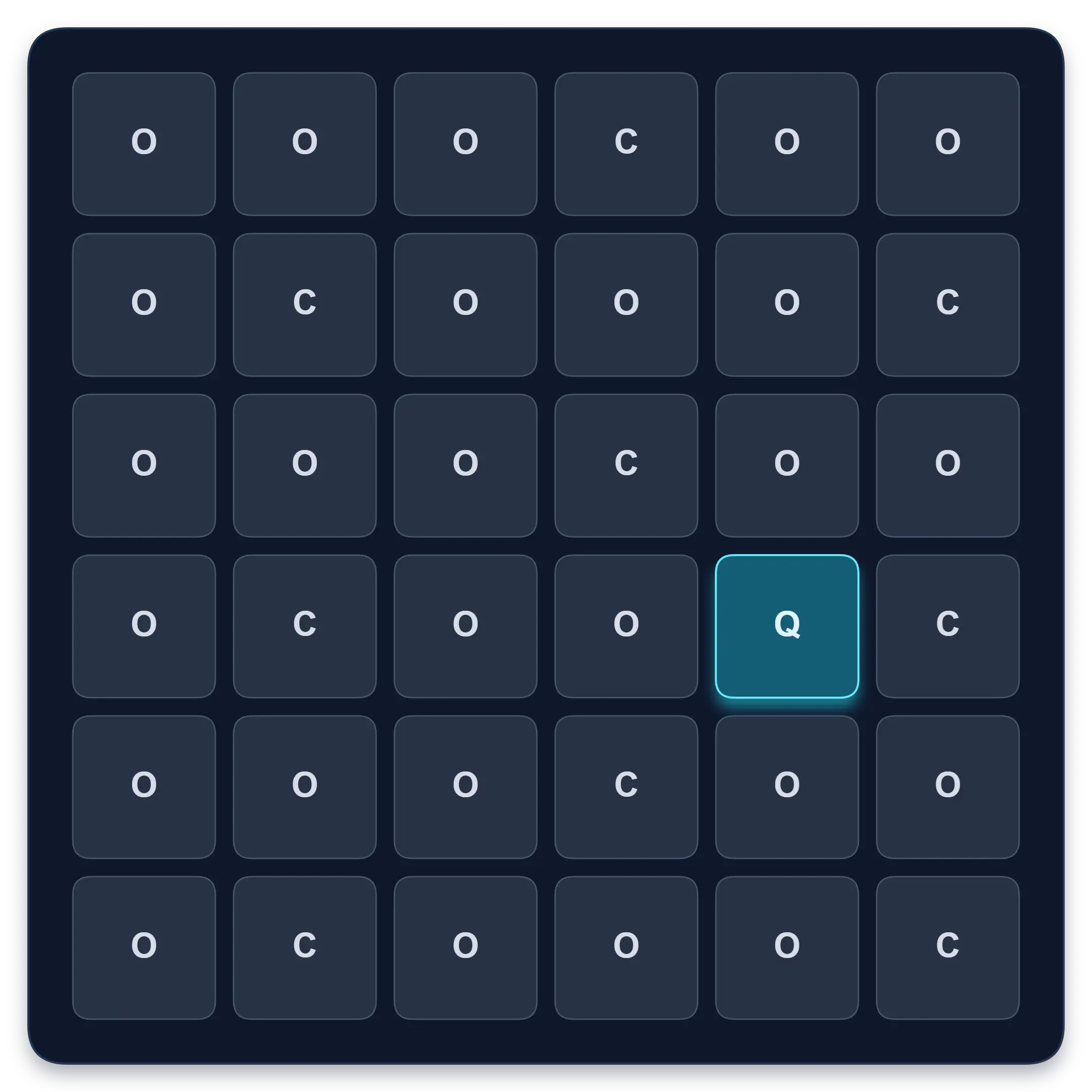
Practise finding targets among distractors. Compare sessions with the same content type and difficulty, looking at accuracy alongside time.
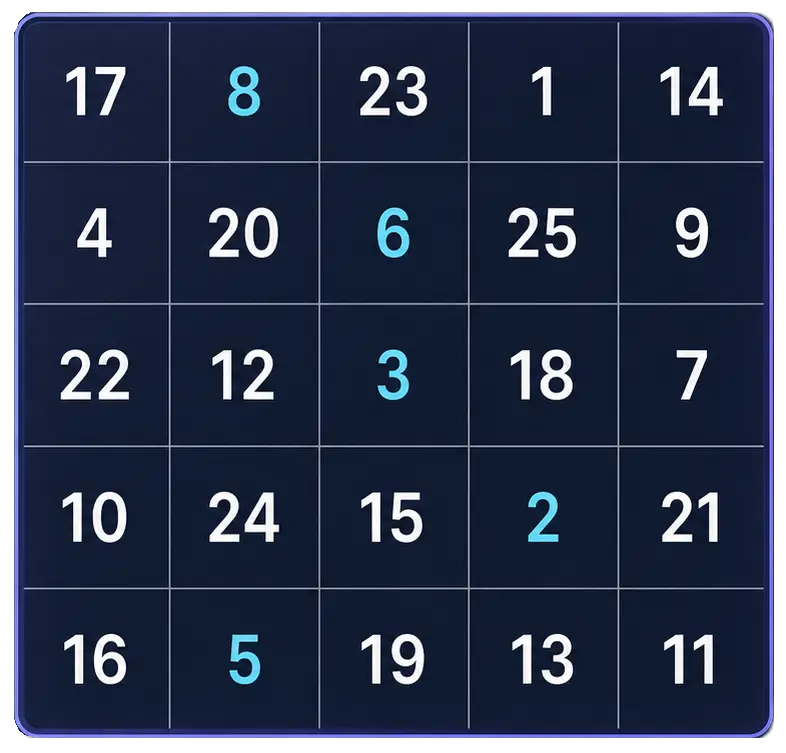
Visual Search TestPractise finding numbers in order. Keep grid size, mode and input device consistent, and compare mistakes as well as completion time.
Schulte Table TrainerMeasure responses to a visual signal. Keep the trial count and device the same; timing and false starts do not establish an everyday focus level.
Reaction Time TestUse several comparable sessions, not just your personal best. Keep interrupted sessions labelled. A new device, changed settings or familiarity with the task can make comparisons misleading. Local history helps you revisit exercise results; it does not measure your work outside the tool.
What the evidence does and does not establish
A 2016 review by Simons and colleagues found stronger support for gains on practised cognitive tasks than for benefits in everyday activities. A better game result therefore does not establish better concentration at work. Simons et al. (2016): review of brain-training evidence
This review does not validate the work log or checking exercise above. They are practical ways to inspect your own output, with no diagnostic cutoff, promised improvement or universal daily target.
Choose the next session from what you learned
- Collect a few comparable records before interpreting a pattern. Five sessions can be a convenient review point, not proof that you have enough data.
- Find a recurring obstacle and change one thing: clarify the finish rule, remove a notification trigger or add a return note. Keep the remaining setup similar.
- Repeat with fresh material and ask whether more work meets the same quality rule at an acceptable time cost. If not, inspect the errors and task difficulty before adding more tracking.
- Keep a change when it is useful in your actual routine and remains useful on later days. Treat a small personal comparison as a working hypothesis, not proof of cause and effect.
For exercise baselines, comparable settings and progress summaries, use the benchmarking guide. Compare browser-exercise results more carefully
Frequently Asked Questions
Short answers that clarify the main value of this article.
How can I measure concentration without an app?
Choose a small task, define a correct result, set a manageable time limit and record the checked output plus unrelated switches. Use paper or your own notes. The log describes that task; it is not a clinical concentration test.
Is there a normal focus score or attention span to aim for?
This method provides neither. The 10-minute block is an example, and different tasks have different demands. Compare similar work against the same quality rule rather than treating a duration or game score as a universal threshold.
Does a better Schulte or reaction-time score mean better focus?
It shows a change in that exercise under those conditions. It does not establish better concentration in reading, studying or work. Check those outcomes separately.
Does a practice streak measure focus?
A streak records that you returned to practice. It does not say whether your output was accurate or whether you stayed with a real-world task. Keep routine and performance as separate observations.
Continue learning
More Quartenson guides connected to this topic.
Benchmark Cognitive Training Progress
Learn how to benchmark cognitive training progress with time, accuracy, mistakes, consistency, streaks, and Quartenson community and this-device comparisons.
Schulte Tables and Speed Reading
Do Schulte tables help you read faster? Separate grid scores from reading progress, try a comprehension check, and build a practical reading routine.
Heat, Cold, and Focus
Hot weather, cold stress, and uncomfortable rooms can affect focus, reaction time, working memory, and productivity. Learn what research shows and how to compare scores safely.
Schulte Table Average Time
Compare 1,000+ Quartenson 5×5 results by Classic and Dynamic mode. See median, 25th and 75th percentiles, and compare your own time fairly.
Try a free tool
Practice the same ideas with a browser-based exercise.
Visual Search Test
Find the target among distractors
Speed • Accuracy • Focus
Visual Search Test
Browser toolGoal: Faster target spotting with better accuracy
Find one target among similar symbols, letters, or numbers. Complete ten short rounds and track median response time, accuracy, and clean results.
Start Visual Search TestFree Schulte Table Trainer
Find the numbers in order
Focus • Scanning • Speed
Free Schulte Table Trainer
Browser toolGoal: Cleaner 5x5 rounds with fewer mistakes
Practice Schulte tables online with a simple browser grid. Choose 3x3 through 7x7, track time and mistakes, and use pause, shuffle, and keyboard controls for quick focus sessions.
Start Free TrainerReaction Time Test
Respond to one visual signal
Median • Fastest • Spread
Reaction Time Test
Browser toolGoal: Response-speed measurement for one visual signal
Wait for an unpredictable visual signal, then respond as quickly as you can. Choose 1 to 10 trials and review your median, average, fastest time, and false starts.
Test Reaction TimeContinue in the app
Use the app when you want structured sessions and longer-term tracking.
Schulte table training with progress
History, heatmaps, pace, and weekly review
History • Heatmaps • Progress
Quartenson: Schulte Tables
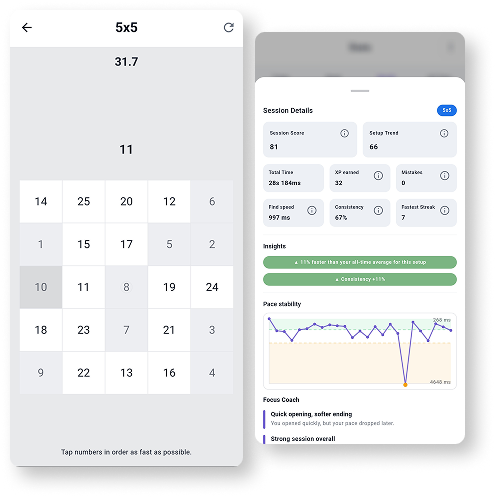
Available nowTrain Schulte tables on Android with session history, pace patterns, heatmaps, achievements, and weekly progress review.
Explore Schulte Tables