Visual Search: Why Some Targets Are Harder to Find
Last updated 7 minutes to read
Visual search means looking for a specified target among other items. One distinctive feature can identify it in a feature search; a conjunction search requires checking a combination of features. Compare our colour and shape examples, then choose a visual-search practice setup whose results you can interpret.
Keep the target; change the neighbours
These original, untimed boards keep the target at row 2, column 2. At a fixed item count, the positions and target stay the same while the distractors change. Knowing the answer is deliberate: inspect the construction rather than trying to beat a clock. Switch between the three conditions, then reveal the target outline.
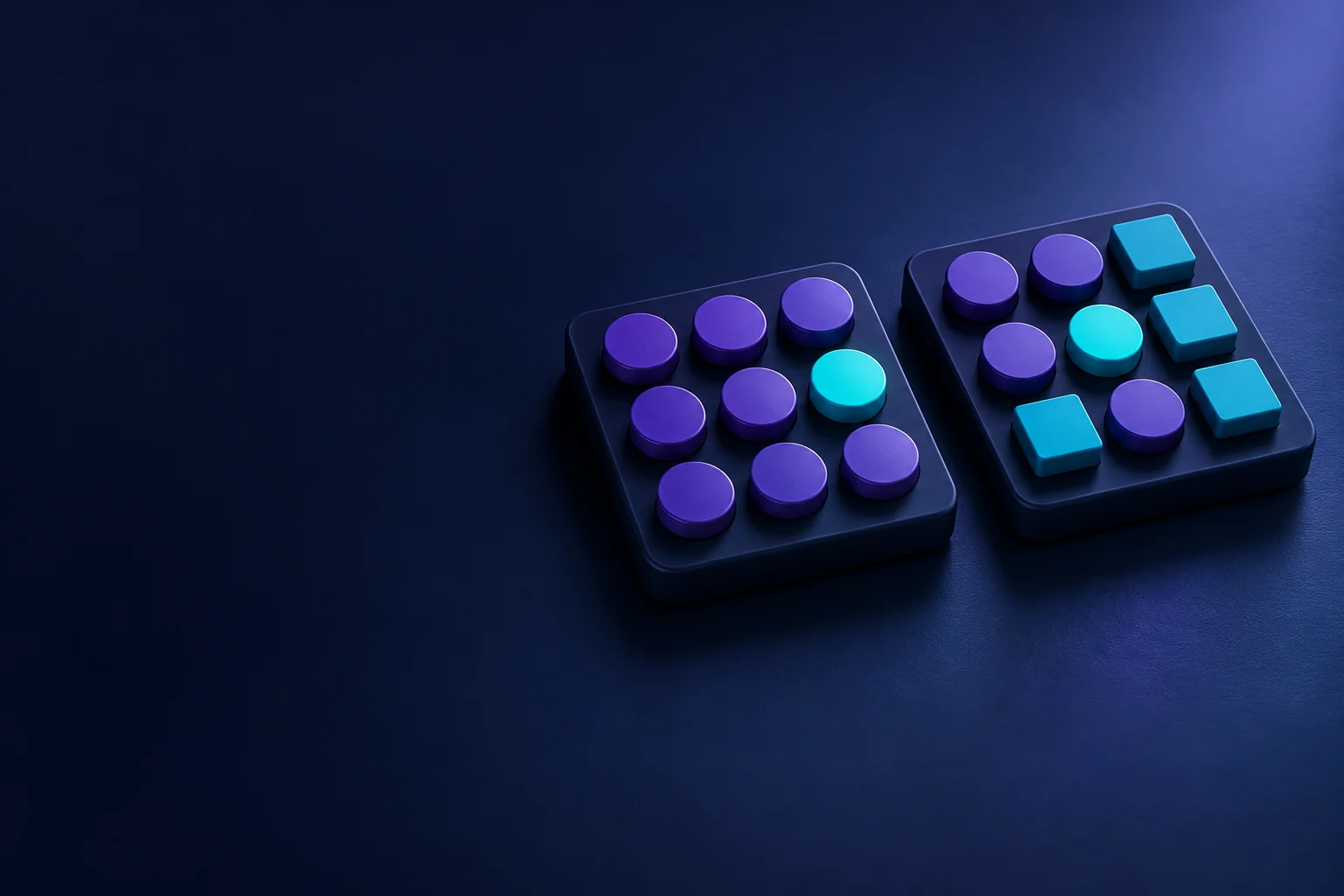
Target: the violet circle. Each board has exactly one.
Distinct colour · 12 items
Original illustrative grid, six columns. Read the description below for the answer without relying on colour. All items are circles; only the target is violet.
Answer: row 2, column 2 (counting from the top left). The target outline is hidden.
Feature search vs conjunction search
In the colour board every item is a circle, so violet is sufficient to identify the target. In the shape board every item is violet, so the circle is sufficient. Each example gives you one distinctive feature.
In the combination board, other items share the target’s colour or its shape. “Find something violet” includes squares; “find a circle” includes cyan items. The complete instruction—violet AND circle—identifies the only target. Research demonstrations distinguish feature search from conjunction search, which requires checking a combination of features. These labels describe task conditions, not two types of people.
“Pop out” is a useful description of a target that stands apart, not a promise that every colour or shape difference is effortless. Visibility, similarity, crowding and the exact display matter. These simple illustrations do not reproduce a research experiment or measure your search strategy.
Change item count separately
Choose 12 or 24 items without changing the search condition. The first twelve items and target stay in place; the larger board adds two rows. This separates adding distractors from changing the target’s defining features.
A larger display gives you more items to inspect, but doubling the items does not establish that your time should double. A familiar layout, display size and many other details can change what you do. This page deliberately records no times and cannot estimate a search slope or compare people.
Changing item count also changes the board’s extent here. A controlled experiment would need to specify spacing, visual angle, target position and other conditions. Treat this as an explanation of one design choice, not an isolated measurement of its effect.
A plausible mistake—and a better check
Suppose you choose a violet square in the combination board. You found the right colour, but stopped before checking the shape. The repair is concrete: restate both requirements and check each candidate against both. Searching only for circles makes the opposite mistake possible.
If the colours are difficult to distinguish, the intended colour example is not a fair task for you. Use the written descriptions and target outline to follow the explanation, or choose a shape/number task with clearly distinguishable items. A missed target here is not evidence of a visual-field problem.
How to practise visual search with comparable settings
Start with items you can distinguish comfortably. If you change practice settings, first change either the number of items or how similar the items are; changing both makes the reason for a different result harder to interpret. The tool’s presets may combine these factors, so record which preset you used when comparing sessions.
Compare accuracy, incorrect selections and clean rounds before speed. A session finishes after ten targets are found; a wrong selection adds an error without advancing the round. The tool does not report missed-response trials. Keep the device, input method and settings consistent. The interactive explanation above is not a practice session: it has no score, history entry or reward. Familiarity with a particular display does not establish broader improvement in study or work.
Try a real visual-search session
The Visual Search tool asks you to find one target per round. Its results belong to that task and setup. For the distinction between searching and judging an off-centre target, use the comparison guide.
- Choose comfortably distinguishable items and one preset in Visual Search. Complete a session before changing the setup.
- Review incorrect responses and accuracy before the response-time summary. Identify whether you missed the target rule or selected a similar distractor.
- If another attempt is useful, repeat with the same preset, device and input method. Use History to review matching sessions; change one setting at a time for a different task. This is an optional practice routine, not a validated training prescription.
Source and scope
The linked PsyToolkit documentation provides the feature/combination-search distinction and an example that varies item count. Our boards, arrangements and explanations are original; no research stimuli, figures, timings or norms are reproduced. The source does not validate this page or demonstrate training benefits.
Quick questions
Short answers that clarify the main value of this article.
Does taking longer mean my focus is worse?
Not by itself. Different targets, distractors, item counts and setups create different tasks. Compare repeated sessions with matching settings and accuracy before interpreting a change in time.
Does the demo collect a score?
No. It is a manually controlled illustration. Switching boards or showing the answer creates no completion, timer, account record or local practice history, and uploads no answers.
Is searching the same as peripheral-awareness practice?
No. This example asks which item matches a target. An off-centre localization exercise asks where a brief target appeared, often while you also judge a central item. Their results are not interchangeable.