Visual Scanning Worksheets with Answer Keys
Last updated 7 minutes to read
These two visual scanning worksheets ask you to find every matching shape, not just one target. Choose a sheet, check both parts of its rule and mark all matches. Finish when you are ready, then use the answer key to review missed targets and incorrect marks separately.
This is an informal, untimed article exercise. There is no age norm, ability rating or claimed treatment effect. The shapes and arrangements were created for this guide; they are not a clinical cancellation test. You can use the screen or print one sheet at a time.
Read the whole target rule
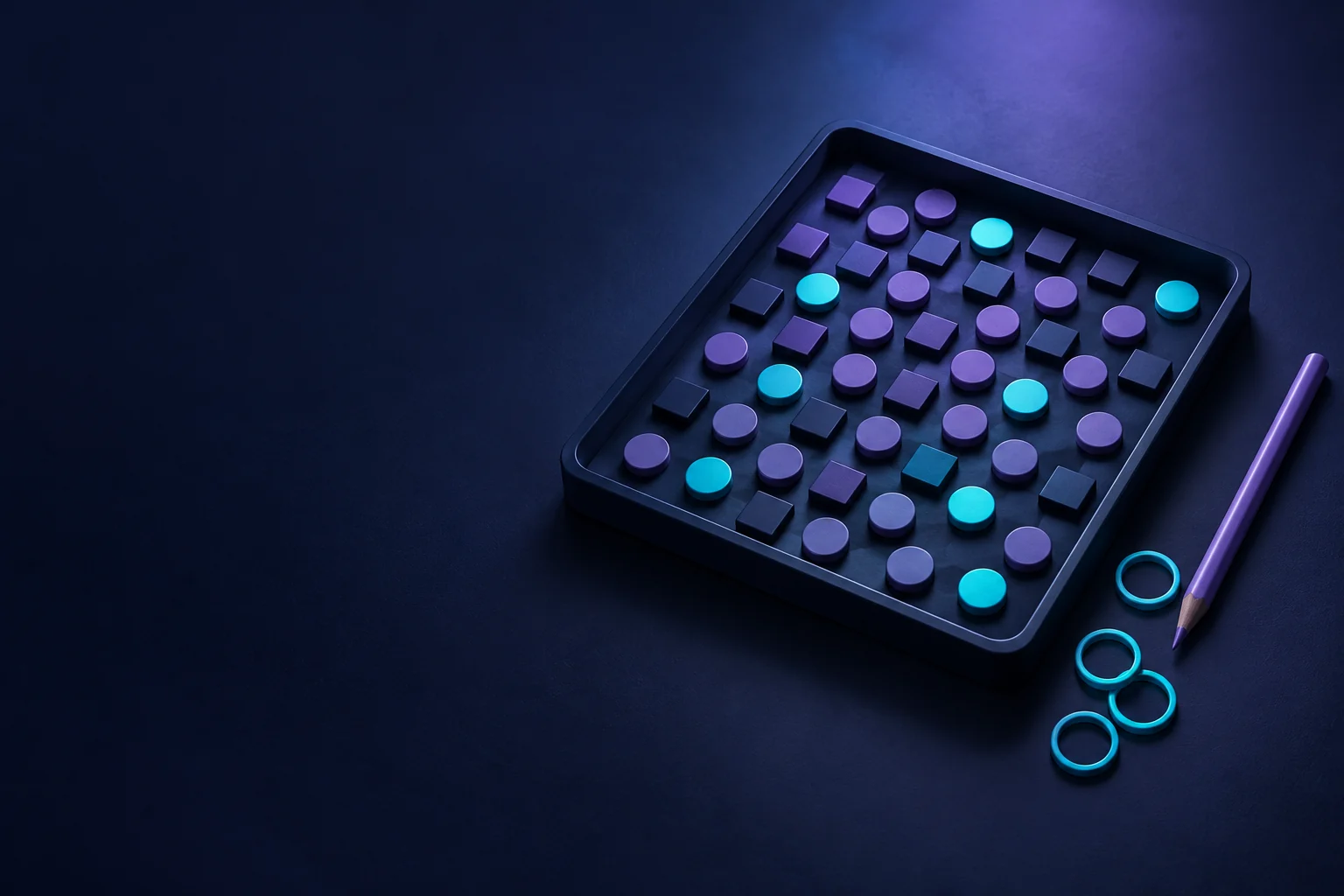
Each board contains circles, squares and triangles, either solid or outlined. Match both the shape and the fill. A solid triangle does not match an outlined triangle, and a solid square does not match a solid triangle. Colour is not needed to tell the targets apart.
The first sheet asks for every solid triangle; the second asks for every outlined circle. Neither task asks you to count all triangles or to find a single unusual item. Read the new rule when you change sheets rather than carrying the previous target forward.
Choose a sheet and find every match
The cells show row–column coordinates. The answer key stays hidden until you finish. All selections disappear when you reset, change sheets or leave the page.
Sheet 1 · solid triangles
Mark every solid triangle. Leave all outlined triangles, circles and squares unmarked.
Target: triangle · solid
Selected: 0
The print view includes only the selected blank sheet; the second button adds its answer key. Your screen selections are never included.
Try a systematic pass
Choose a route through the board, such as one row at a time from left to right. Mark a cell only when both features match. Before finishing, revisit the rows you are unsure about and check the target rule again. This is a practical suggestion, not a proven best scanning strategy for everyone.
- Identify the target shape and whether it is solid or outlined.
- Work through all six rows. On screen, select or unselect a cell with a click, tap, Enter or Space.
- Use the Finish and check button when you decide you have found every match.
- Compare the coordinate answer key with your selections or paper marks. Start a fresh attempt only if it would be useful.
Review omissions and extra marks separately
A missed target is a matching cell you left unmarked. An incorrect mark is a nonmatching cell you selected. Both matter: selecting everything removes omissions but creates many incorrect marks. The exercise reports the two counts separately instead of combining them into a speed or attention score.
For example, if you marked an outlined triangle on the first sheet, check the fill part of the rule. If your mistakes cluster near a row boundary, inspect that transition next time. These are clues about this attempt, not explanations of a health condition or a measure of general concentration.
Resetting the same board does not create new material. Once you know the coordinates, a better second attempt may reflect memory of the sheet. Different screen sizes, paper sizes and viewing conditions also make informal comparisons uncertain.
For a different task, try finding one target across fresh rounds in the Visual Search tool. Its timed results are separate from these untimed worksheets and should not be compared as the same score.
Questions about the worksheets
Short answers that clarify the main value of this article.
Is there a good completion time?
No timing norm is provided. These fixed boards are for understanding a rule and reviewing matches, omissions and extra marks, not comparing people.
Can I print a sheet without the answers?
Yes. Select a sheet and use Print selected sheet. The separate Print with answer key button includes the coordinate key. Native print and save-as-PDF behavior depend on your browser.
Does this test eyesight or diagnose attention difficulties?
No. It is a small informal matching exercise, not a visual-field test, diagnosis, rehabilitation program or measurement of general ability.