

How to Improve 5×5 Schulte Table Time | 14-Day Plan
Last updated 8 minutes to read
Quick answer: how do you improve Schulte table time?
To improve your Schulte table time, stop judging yourself only by your fastest attempt. Use the same grid size and device, establish a clean baseline from several rounds, and practice in short sessions.
Focus first on reducing mistakes and long pauses. Then work on completing several rounds at a similar pace. A lower median clean time is stronger evidence of improvement than one unusually fast personal best.
Measure
Use several clean rounds, not one result.
Practice
Complete short, focused sets instead of many tired rounds.
Improve
Reduce hesitation while keeping accuracy stable.
Compare
Use the same grid size, mode, and device.
Not sure whether your current result is fast or slow? Read the Schulte table average-time guide.
What does a better Schulte table time actually mean?
A better Schulte table time means you are finding numbers faster while keeping the round controlled. Speed, accuracy, and repeatability should move together.
Suppose you complete one 5x5 table in 34 seconds with five mistakes, but another in 43 seconds with no mistakes. The 34-second attempt is faster, but the 43-second round is usually the better training result because it is clean and easier to compare.
A personal best shows what happened once. Median clean time shows what you can usually do.
For basic setup and technique, read how to use Schulte tables correctly.
Measure your current 5x5 baseline
Before trying to improve, measure where you are now. Without a baseline, it is easy to mistake a lucky round for progress or a tired round for decline.
- Use a 5x5 number grid.
- Use the same device and table settings.
- Complete five rounds.
- Rest briefly between rounds.
- Record completion time and mistakes.
- Separate clean rounds from rushed or error-heavy rounds.
- Calculate the median clean time.
Zero-mistake rounds are best for strict comparison. If you do not have enough of them, use a consistent low-error threshold such as zero or one mistake. This is a practical personal-comparison method, not an official Schulte table standard.
| Round | Time | Mistakes | Use in baseline? |
|---|---|---|---|
| 1 | 48.6 seconds | 0 | Yes |
| 2 | 44.9 seconds | 1 | Yes |
| 3 | 37.5 seconds | 4 | No |
| 4 | 46.1 seconds | 0 | Yes |
| 5 | 45.4 seconds | 0 | Yes |
The fastest round was 37.5 seconds, but it included four mistakes. It should not define the baseline. The clean results are 44.9, 45.4, 46.1, and 48.6 seconds. Their median clean time is about 45.8 seconds.
Median clean time is the middle result after clean times are sorted from fastest to slowest. For an even number of clean results, use the average of the two middle values.
Want a quick baseline now? Open the free Schulte table trainer and repeat the same settings for several clean rounds.
Keep the same mode when measuring improvement. Classic and Dynamic results should not be mixed; read Classic vs Dynamic Schulte Tables for the details.
For a deeper explanation of clean median time and consistency, read how to track Schulte table progress.
Diagnose what is slowing down your Schulte table time
Different problems require different practice. Doing more rounds without identifying the bottleneck can reinforce the same habits rather than improve them.
| What you notice | Likely practice problem | What to work on |
|---|---|---|
| Many wrong taps | You are forcing speed too early | Accuracy-reset rounds |
| Clean but consistently slow | Long search pauses | Controlled-speed drills |
| Strong start, slow finish | Fatigue or rushed early pacing | Shorter sets and more rest |
| Results vary widely | Inconsistent rhythm | Three-round consistency sets |
| Fast on 4x4, much slower on 5x5 | Difficulty scanning the larger area | More 5x5-specific practice |
| Time improves but errors rise | Speed is hiding weaker control | Return to clean rounds |
| Results change dramatically by device | Screen and input conditions affect comparison | Use one setup for benchmarking |
Do not solve every problem by trying to tap faster. First decide whether the main bottleneck is accuracy, hesitation, fatigue, or inconsistency.
Use a calm, repeatable scanning technique
Begin each round with a relaxed gaze near the center of the table. Do not force your eyes to remain perfectly fixed, and do not chase every number with sharp, frantic movements.
Allow your eyes to move naturally while trying to keep awareness of the wider grid. The goal is not to eliminate eye movement. It is to reduce unnecessary searching and panic.
As you practice:
- avoid guessing where the next number might be
- tap only after you have identified the target
- keep your hand ready without covering the grid
- maintain a steady pace instead of sprinting through the first numbers
- reset mentally after a mistake rather than rushing to recover
A rigid central stare is not required. Use a relaxed central starting position, then allow natural eye movement as you search.
For more about the visual-scanning side of the exercise, read the peripheral vision training guide.
Five drills for improving Schulte table time
Do not perform every drill in one session. Choose the drill that matches your current bottleneck.
Accuracy reset
- Purpose
- Reduce random taps and rebuild control.
- How
- Complete one 5x5 round deliberately more slowly than normal. Do not chase a fast result. Try to finish with zero mistakes.
- When
- Use this drill when recent fast attempts contain repeated errors.
Controlled-speed ladder
- Purpose
- Build speed without starting directly at maximum difficulty.
- How
- Complete one clean 4x4 round, then two controlled 5x5 rounds. Keep the first 5x5 comfortable and use the second to increase pace slightly without adding mistakes.
- When
- Use this when 5x5 feels chaotic but smaller grids feel controlled.
Three-round consistency set
- Purpose
- Make performance more repeatable.
- How
- Complete three 5x5 rounds with 60-90 seconds of rest between them. Do not aim for a personal best. Try to keep all three clean results within a narrow range.
- When
- Use this when results vary dramatically from one round to another.
Hesitation review
- Purpose
- Notice where your pace breaks down.
- How
- After each round, write one short note: where did rhythm drop, did one mistake cause rushed taps, or did you rescan the same part of the grid?
- When
- Use this when your time stays flat even though mistakes are low.
Finish-strong round
- Purpose
- Prevent pace from collapsing near the end.
- How
- Complete one 5x5 round at a controlled pace. During the final ten numbers, maintain the same calm rhythm instead of accelerating or becoming tense.
- When
- Use this when you usually start fast but finish slowly.
Add a separate target-finding exercise
For variety, the Visual Search Test provides a separate target-finding exercise. It should complement direct 5x5 practice, not replace it.
Open Visual Search TestA practical 14-day Schulte table improvement plan
This plan is designed as a structured experiment, not a guaranteed transformation. It gives you a consistent way to test what changes after two weeks of focused practice.
Keep each session under 5-10 minutes. Most training days should contain no more than three focused rounds.
Stop if your attention becomes tired or mistakes begin rising sharply. The plan does not guarantee a specific improvement.
Week 1: Control and diagnosis
| Day | Practice |
|---|---|
| 1 | Measure a five-round 5x5 baseline |
| 2 | One accuracy-reset round + two clean 5x5 rounds |
| 3 | One 4x4 round + two controlled 5x5 rounds |
| 4 | Three-round consistency set |
| 5 | Rest, or one relaxed round only |
| 6 | Hesitation review + two 5x5 rounds |
| 7 | Three clean benchmark rounds |
Week 2: Consistency and retesting
| Day | Practice |
|---|---|
| 8 | Rest |
| 9 | One accuracy-reset round + two controlled rounds |
| 10 | Controlled-speed ladder |
| 11 | Three-round consistency set |
| 12 | Rest, or one relaxed round |
| 13 | Three clean 5x5 rounds |
| 14 | Repeat the original five-round benchmark |
Use the same device, grid size, mode, and input method for Day 1 and Day 14. Compare median clean time, total mistakes, fastest clean result, consistency spread, and how controlled the final numbers felt.
Do not expect the same improvement rate as another user. Random layouts, previous experience, fatigue, and practice quality all affect the result.
Free Online Schulte Table Trainer
Start with a clean 5x5 round, track your result, and repeat the same setup when measuring progress.
Start Free PracticeHow often should you practice Schulte tables?
A reasonable starting routine is five to ten minutes, three to five times per week. That usually provides enough repetition to compare results without turning every session into tired clicking.
More practice is not automatically better. Stop or switch to an easier round when mistakes rise repeatedly, your times become much slower, you feel tense, or you begin guessing instead of actively searching.
End the session while your technique is still controlled. Do not wait until every round becomes worse.
Track progress without over-reading one round
Track a small group of metrics that show whether your normal performance is becoming faster, cleaner, and more stable. This keeps one lucky layout from distorting the conclusion.
| Metric | What it shows |
|---|---|
| Median clean time | Your typical controlled completion time |
| Mistakes per round | Whether speed is damaging accuracy |
| Fastest clean time | Your best controlled performance |
| Consistency spread | How widely clean results vary |
| Clean completion rate | How often you finish within your mistake limit |
Consistency spread is slowest clean time minus fastest clean time. Clean completion rate is clean rounds divided by total rounds, multiplied by 100.
Copyable comparison template
Day 1 versus Day 14 summary
Median clean time:
Fastest clean time:
Mistakes:
Consistency spread:
| Result pattern | Interpretation |
|---|---|
| Lower median clean time, stable mistakes | Strong evidence of improvement |
| Same median clean time, fewer mistakes | Accuracy has improved |
| Same best time, narrower spread | Performance is becoming more consistent |
| Faster best time, much higher error rate | Likely rushing rather than reliable progress |
| One fast day followed by normal results | Probably an isolated personal best |
Example: if Week 1 has a median clean time of 48 seconds, a 15-second consistency spread, and 1.8 mistakes per round, Week 2 is more convincing if median clean time drops to 44 seconds, spread narrows to 8 seconds, and mistakes fall to 0.8 per round.
What to do when your Schulte table time stops improving
A plateau does not necessarily mean the exercise has stopped working. It may mean that your practice has become repetitive, your sessions are too long, or you are comparing noisy results.
- Take one or two rest days.
- Return to an accuracy-reset round.
- Compare median clean time rather than personal records.
- Keep device and settings consistent.
- Reduce the number of rounds per session.
- Choose one specific bottleneck to train.
- Avoid increasing grid size just to make practice feel harder.
A stable time with fewer mistakes is still progress. A narrower result range is also progress.
Common mistakes that prevent faster Schulte table results
Chasing a personal best every round
Maximum-effort attempts create noisy results and often increase errors. Most practice rounds should feel controlled.
Practicing too many rounds
Long sessions can turn visual scanning into tired repetition. Use shorter sets and stop when quality drops.
Ignoring mistakes
A faster time with several wrong taps is not automatically a better result.
Changing settings constantly
Different devices, grid sizes, and modes make progress difficult to compare.
Starting with grids that are too large
Larger grids are not automatically better. Use a size that lets you maintain technique.
Using only the fastest result
One lucky layout can produce an unusually fast time. Compare median clean time and consistency instead.
Practice with a free Schulte table online
Use the free Quartenson trainer to establish your baseline and follow the 14-day routine. Choose a grid size, complete a round, and review your completion time and mistakes directly in the browser.
Free Online Schulte Table Trainer
Start with a clean 5x5 round, track your result, and repeat the same setup when measuring progress.
Start Free PracticeNeed help interpreting the result? Read what a good 5x5 Schulte table time looks like in the Schulte table average-time guide.
Review progress beyond one session
The browser trainer is useful for quick practice. Quartenson: Schulte Tables is designed for users who want to review progress across multiple sessions.
The app can help you examine session history, completion time, mistakes, pace patterns, activity, and weekly or monthly trends instead of relying only on one personal best.
Track Your Schulte Practice
View your training history and review how your results change over time.
Explore Schulte TablesSchulte table improvement FAQ
How quickly can I improve my Schulte table time?
There is no guaranteed timeline. Some users may notice cleaner or more consistent rounds early, while larger time improvements can take longer. Compare several clean sessions over at least one or two weeks rather than expecting every round to become faster.
Should I practice Schulte tables every day?
Daily practice is not required. Short sessions three to five times per week are a reasonable starting point. Rest when mistakes, tension, or fatigue increase.
Is it better to practice 4x4 or 5x5?
Use 4x4 to learn control or warm up, but practice 5x5 regularly if your goal is to improve a classic 5x5 result. Smaller-grid speed does not automatically transfer perfectly to larger grids.
Should I keep my eyes fixed on the center?
Start with a relaxed gaze near the center, but do not force your eyes to remain completely still. Natural eye movement is expected. The goal is to avoid frantic searching, not to lock your gaze rigidly.
What is a good 5x5 Schulte table time?
A good result depends on accuracy, experience, and testing conditions. A clean result under 60 seconds is a practical beginner goal, while 30-45 seconds is a solid casual-practice range. Read the Schulte table average-time guide for more detail.
Why am I getting slower instead of faster?
Fatigue, repeated maximum-effort rounds, harder random layouts, device changes, or rising mistakes can all make results slower. Take a short break and compare several clean rounds before concluding that your performance declined.
Do mistakes count when measuring improvement?
Yes. A faster result with more mistakes may reflect rushing rather than better control. Track both completion time and accuracy.
Will larger Schulte tables improve my 5x5 time?
Larger grids can add variety and difficulty, but they are not required for improving a 5x5 result. Direct 5x5 practice should remain part of the routine when 5x5 performance is the goal.
Practice next
Ready to measure a clean baseline? Open the free Schulte table trainer.
Continue learning
More Quartenson guides connected to this topic.
Classic vs Dynamic Schulte Tables
Classic and Dynamic Schulte tables are different exercises. Learn how shuffle mode changes the task, when to use each mode, and why results should not be compared directly.
Schulte Table Average Time
Compare 1,000+ Quartenson 5×5 results by Classic and Dynamic mode. See median, 25th and 75th percentiles, and compare your own time fairly.
How to Use Schulte Tables Correctly
Learn the correct Schulte table routine for beginners: choose a grid size, practise clean 5×5 rounds, avoid rushing, and track time with accuracy.
Track Schulte Table Progress
Learn how to track Schulte table progress with clean median time, mistakes, consistency spread, personal bests, and recent history instead of relying only on one fastest result.
Try a free tool
Practice the same ideas with a browser-based exercise.
Free Schulte Table Trainer
Find the numbers in order
Focus • Scanning • Speed
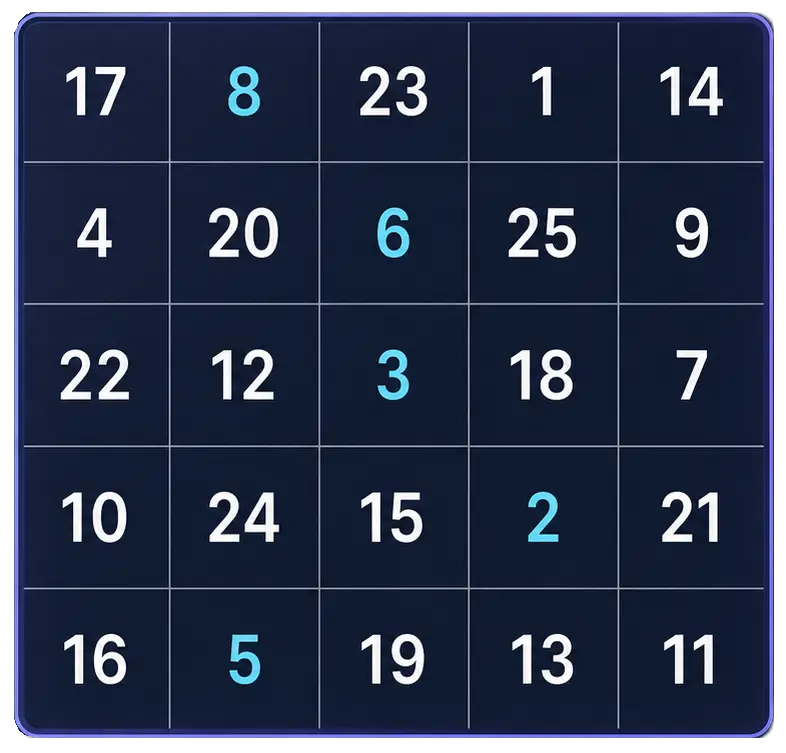
Free Schulte Table Trainer
Browser toolGoal: Cleaner 5x5 rounds with fewer mistakes
Practice Schulte tables online with a simple browser grid. Choose 3x3 through 7x7, track time and mistakes, and use pause, shuffle, and keyboard controls for quick focus sessions.
Start Free TrainerReaction Time Test
Respond to one visual signal
Median • Fastest • Spread
Reaction Time Test
Browser toolGoal: Response-speed measurement for one visual signal
Wait for an unpredictable visual signal, then respond as quickly as you can. Choose 1 to 10 trials and review your median, average, fastest time, and false starts.
Test Reaction TimeContinue in the app
Use the app when you want structured sessions and longer-term tracking.
Schulte table training with progress
History, heatmaps, pace, and weekly review
History • Heatmaps • Progress
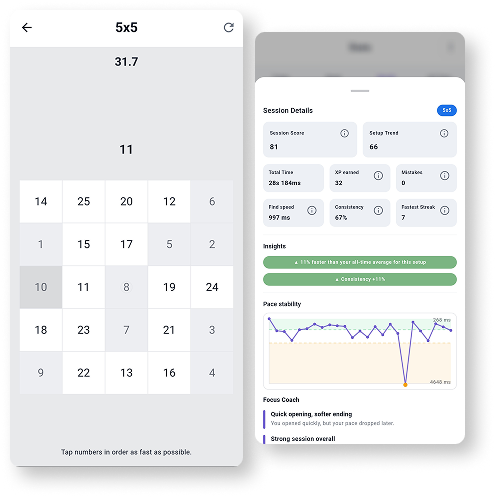
Quartenson: Schulte Tables
Available nowTrain Schulte tables on Android with session history, pace patterns, heatmaps, achievements, and weekly progress review.
Explore Schulte Tables