Backward Digit Span: How to Play and Read Your Result
Last updated 4 minutes to read
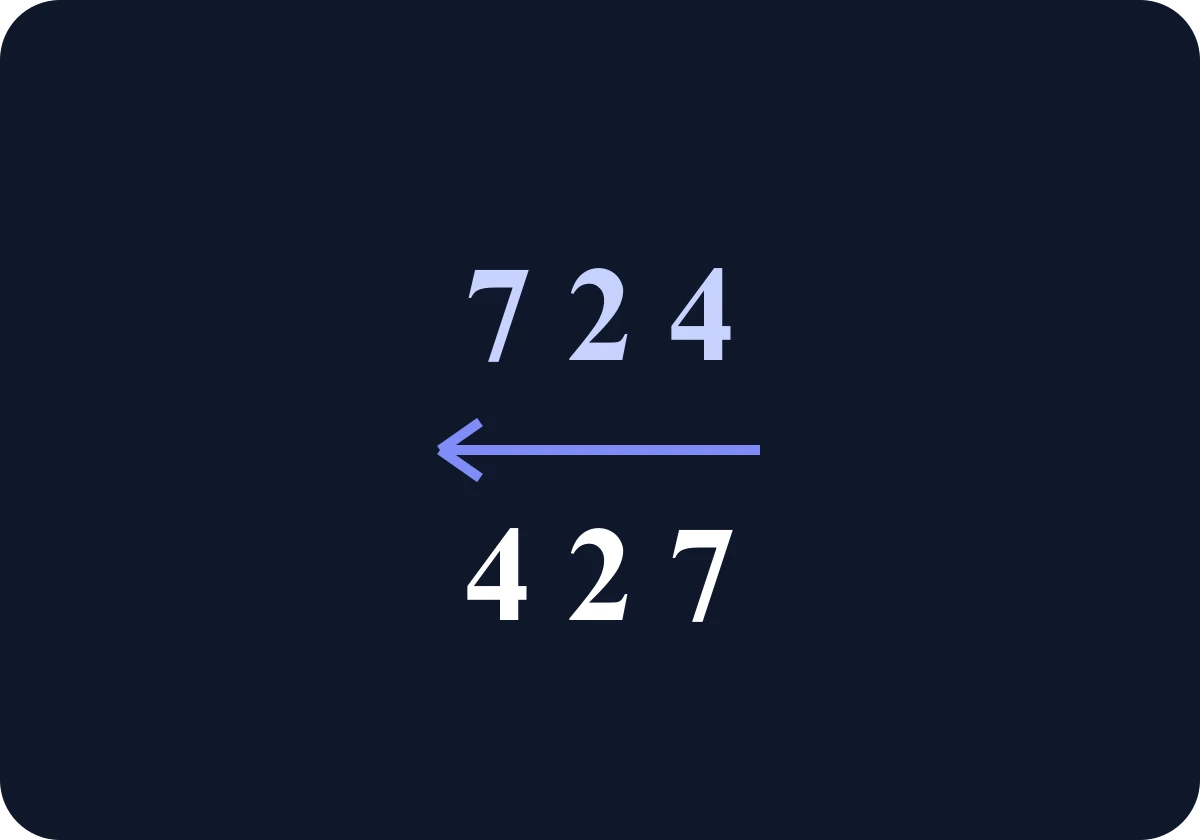
Backward digit span asks you to hold a short sequence in mind and give it back in reverse order. The important part is order, not arithmetic. Here is the rule, a starting setup and a useful way to read the result of our free browser exercise.
Reverse the sequence, not the digits themselves
If the digits appear as 4, then 7, then 0, wait until they disappear and enter 074. Treat them as a sequence, not the number seventy-four: the zero must stay.
| Shown in order | Your response | Why |
|---|---|---|
| 4 → 7 → 0 | 0 → 7 → 4 | Correct: last digit first |
| 4 → 7 → 0 | 4 → 7 → 0 | Incorrect: original order |
| 4 → 7 → 0 | 0 → 4 → 7 | Incorrect: sorting is not reversal |
This is an original teaching example. The actual exercise generates a fresh sequence each round.
Try eight rounds with a consistent setup
Start with three digits. Each digit is visible for 900 ms, followed by a 200 ms gap. After presentation, use the number pad or keyboard to enter the full reversed sequence and check your answer. There is a 30-second response window.
- Fixed is the default: the chosen length stays the same for all eight rounds. In optional Flexible mode, a correct answer adds one digit and a wrong or skipped answer removes one, within 2-9 digits.
- Complete all eight rounds. Skip records an unanswered round, not a correct response.
- Avoid notes and screenshots if you want an unaided recall comparison. If you use a strategy such as grouping, keep it consistent and note it for yourself.
What does the longest correct span mean?
It is the longest sequence you reproduced correctly during that run. It is not the length reached after an error, an average span or a clinical score. An isolated correct long sequence says less about consistency than the same span alongside several correct rounds.
Read longest span together with correct rounds out of eight and unanswered rounds. Compare runs with the same starting length, device, input method and approach. Keep fixed and flexible modes separate, and compare only matching digit timing and length.
Make the next attempt useful
First check whether errors came from forgetting a digit, retaining the original order or mistyping the answer. Choose one adjustment, such as slowing your entry after recalling the sequence, then try the same setup again later. You do not need to chase nine digits.
For a different task, N-back asks you to update positions continuously rather than reverse one whole sequence. Neither task result establishes general intelligence, a diagnosis or improvement in everyday memory.
Source and scope
Woods and colleagues (2011) studied computerized digit-span assessment. Their work is context for why task administration and scoring matter, not a norm table or validation of this eight-round game. The instructions and examples here describe Quartenson’s implementation.
Woods et al. (2011): Improving digit span assessment of short-term verbal memory
Quick questions
Short answers that clarify the main value of this article.
What is a good backward digit span?
There is no supported population cutoff for this game. Use accuracy and longest correct span across several runs with the same setup; do not compare its result directly with a standardized assessment.
Is backward digit span the same as forward digit span?
No. Forward recall preserves the presentation order. Backward recall reverses it. A score from one task is not interchangeable with the other.