N-back Explained: How 1-back, 2-back and 3-back Work
Last updated 4 minutes to read
In N-back, the current item is compared with the one N steps earlier. The moving comparison is the whole rule: 2-back does not mean remembering two items and answering at the end. Here is how to follow it without accidentally playing 1-back.
A worked 2-back example
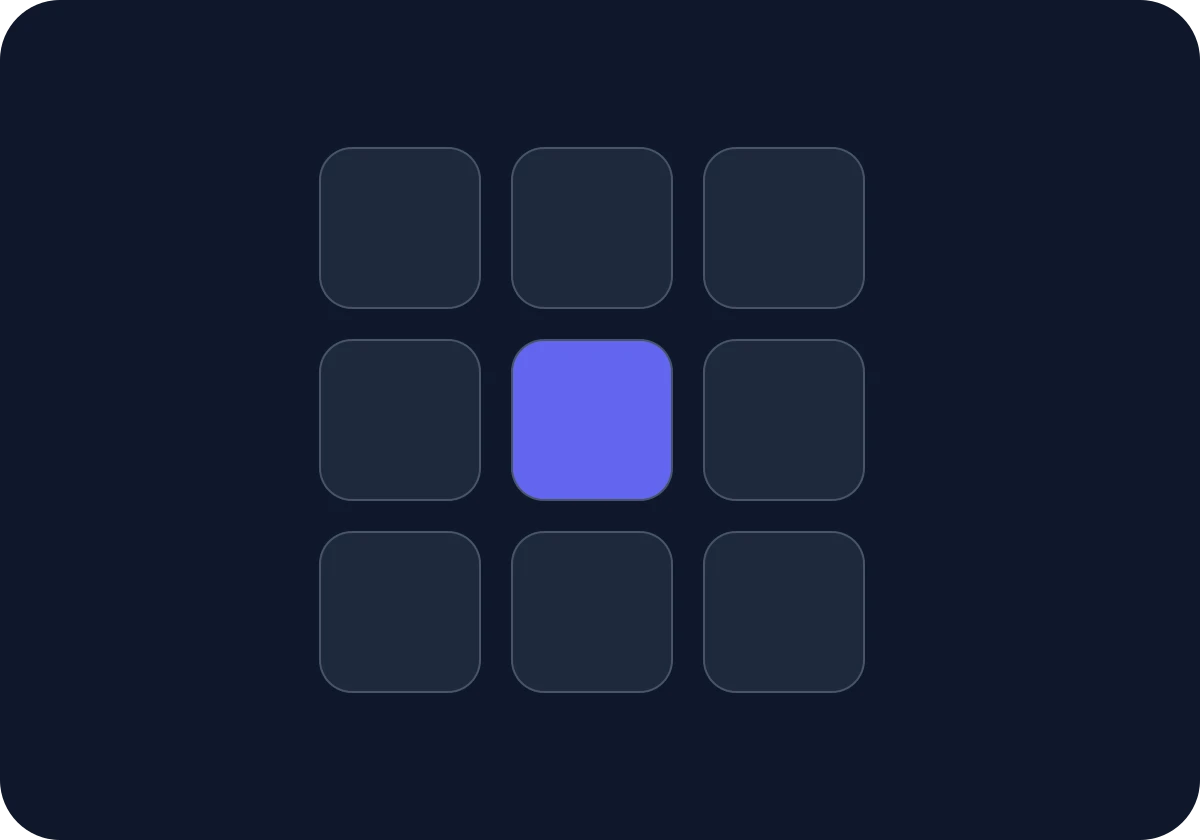
Imagine positions A, B, A, A, C. These letters are labels for grid locations, not letters shown by the game. On each scored step, compare the current location with the one exactly two steps earlier.
| Step / location | Compare with | Response |
|---|---|---|
| 1: A; 2: B | Nothing yet | Warm-up: remember both |
| 3: A | Step 1: A | Match |
| 4: A | Step 2: B | No match |
| 5: C | Step 3: A | No match |
Step 4 is the common trap: it repeats the immediately previous location, but does not match two steps back. This is an original explanation, not a copied research sequence.
Start with the rule, then adjust difficulty
Try 1-back at 3.5 seconds per position. Move to 2-back when you can follow the comparison rule comfortably; try 3-back as a separate setting rather than a better version of the same score. Our tool uses one visual stream on a nine-cell grid, not dual N-back with simultaneous visual and sound streams.
- The first N positions are warm-up: remember them without answering. They are outside the twenty scored trials.
- Then choose Match or No match on every trial, using the buttons or M / N. A position flashes for 500 ms; you can respond during the rest of the chosen 1.5, 2.5 or 3.5-second interval.
- An unanswered response window counts as a miss. Update the comparison after every position, even after a mistake.
Why accuracy alone can mislead
Each session has six matching and fourteen non-matching scored trials. Always choosing No match therefore scores 14/20, or 70%, while detecting none of the matches. That is a response pattern, not successful use of the N-back rule.
Read hits (correct Match responses), false alarms (Match on a non-match), and unanswered trials beside overall accuracy. For example, 70% with zero hits means something different from 70% while detecting several targets. Response time includes answered trials, so a faster median with more mistakes is not automatically better.
Compare like with like
Repeat the same N level and pace on the same device and input method before comparing sessions. If you lose the sequence, pause or restart rather than speeding through guessed answers. Change one setting at a time so you know what changed.
Backward Digit Span offers a contrasting task: remember a complete digit sequence, then reverse it. Better scores in either exercise show performance on that task; they do not by themselves establish IQ gains or transfer to studying and daily life.
Source and scope
Kirchner’s 1958 paper is an early research reference for the N-back task. It is historical context, not validation of Quartenson’s visual grid, difficulty settings or scoring. The example and metric explanation here come from our implementation.
Kirchner (1958): Age differences in short-term retention of rapidly changing information
Quick questions
Short answers that clarify the main value of this article.
Is this dual N-back?
No. This is single visual N-back: only grid locations must be compared. Dual N-back adds a second simultaneous stream, commonly sound, and is a different task.
What is a good N-back score?
This tool has no population norm. Compare the same N and pace, and check hits, false alarms and unanswered trials. A high total based mainly on No match responses can conceal missed targets.