

Do Schulte Tables Help With Speed Reading?
Last updated 5 minutes to read
What a Schulte table actually asks you to do
In a classic 5×5 Schulte table, you find the numbers 1 to 25 in order in a shuffled grid. You search for a known target, select it, and move to the next. Completion time and mistakes describe performance on that task.
Reading asks a different question: what do these words mean together? Finding a number does not test vocabulary, the reasoning in a paragraph, or whether you noticed an exception. Do not convert seconds on a grid into words per minute or treat a new grid record as evidence of better reading.
Choose the result you need before choosing a speed
Finish the sentence: ‘After reading, I need to be able to…’ Use that answer to decide how much detail matters. Getting through a page is not the same as getting what you need from it.
- For an overview: skim the headings, opening and conclusion to decide which parts deserve closer reading.
- For a specific fact: scan for the name, date or phrase, then read the surrounding passage for conditions and exceptions.
- For understanding: read the relevant passage carefully, explain its main point and reasons, and check your explanation against the text.
Practise choosing between skimming, scanning and careful reading
Try a reading session with an answer check
Choose a short, unfamiliar section of something you actually need to read. The following is a practical self-check, not a standardized reading test or a validated training programme. You do not need a Schulte warm-up first.
- Write down one question the passage should answer. Keep the text length and difficulty manageable.
- Read at a comfortable pace. If you time it, include necessary rereading rather than treating it as a failure.
- Look away. State the main point, one supporting reason, and a condition or limitation if the passage contains one.
- Reopen the text and check each statement. Mark what was missing or inaccurate, not just what sounded familiar.
- Repair the specific gap: look up an unfamiliar term, reread the sentence that connects two ideas, or write the exception next to your answer.
If you need to remember it later, turn your notes into recall questions
A quick example: did you keep the condition?
Read this original fictional notice, then look away and answer the questions before revealing the check. This is a practice example, not workplace guidance or a speed test.
The library will open its study room until 9 p.m. on Tuesdays during October. The trial is intended for evening-course students, but all members may use the room. Staff will review attendance before deciding whether to continue in November. The later closing time does not apply to the rest of the library.
- What changed, and when?
- Who can use the room?
- Is the November extension confirmed?
- Does the whole library stay open later?
Check your answers
Only the study room stays open until 9 p.m. on Tuesdays in October. All members may use it. November is not confirmed: staff will review attendance first. The rest of the library keeps its usual hours.
If you remembered ‘the library closes at 9’ but missed the room, day or trial period, return to those conditions and rewrite the answer. The useful result is a correct explanation, not a fast but misleading summary.
Measure reading, not just finishing time
If you want a pace figure, use words read ÷ reading time in minutes. A 600-word passage read in 3 minutes is 200 words per minute. This is an arithmetic example, not a target or a ‘good reader’ threshold.
Record the passage, purpose, time, answer-check result and what you needed to repair. Compare several unfamiliar passages of similar length, topic, language and difficulty using the same kind of questions. Rereading the same passage is useful practice, but familiarity makes it a poor comparison for a new-text speed claim.
Finishing sooner while missing the main reason or an important condition is not a win for an understanding task. If you get stuck on terminology, work on the terms in context. If you keep losing your place, try a quieter setting and shorter sections. Change one thing and check the next passage.
Keep Schulte scores in a separate log. Even an improvement in both logs would not, by itself, show that the grid caused the reading change.
Where an optional Schulte round fits
If you want number-finding practice, try one round on a comfortable grid size and review time together with mistakes. One round is simply a small starting point, not a research-established reading dose. Skip it if your available time is better spent on the text.
Quartenson’s free trainer supports 3×3 through 7×7 grids. It measures the grid exercise, not reading comprehension. You do not need to fix your gaze rigidly or try to take in a whole page at once to use this reading routine.
What the reading research supports
Rayner and colleagues’ 2016 review describes a trade-off between reading speed and understanding. Large increases, such as doubling or tripling speed while preserving comprehension, are unlikely. It points to reading practice and language knowledge, including vocabulary, rather than a simple speed-reading shortcut.
Rayner et al. (2016): So Much to Read, So Little Time
This is a review of reading research, not a trial of Quartenson or proof of Schulte-to-reading transfer. The routine and fictional notice above are our practical suggestions, not exercises tested by that review.
Frequently Asked Questions
Short answers that clarify the main value of this article.
Are Schulte tables a proven way to increase reading speed?
The evidence cited here does not establish that. A Schulte result measures ordered number finding. Check reading pace and comprehension on text separately, and do not assume that improvement transfers between them.
How many Schulte rounds should I do before reading?
There is no reading-training dose established by the source used here. A round is optional if you enjoy the exercise; you can go straight to reading and checking your understanding.
Should I stop rereading to read faster?
Do not make zero rereading your goal. If a sentence is unclear, go back to resolve it. Judge whether you can explain the passage accurately, not whether your eyes only moved forward.
Continue learning
More Quartenson guides connected to this topic.
Skimming, Scanning, and Careful Reading
Choose skimming for an overview, scanning for a fact, and careful reading for meaning. Try report, email, and study examples with answer checks.
How to Use Schulte Tables Correctly
Learn the correct Schulte table routine for beginners: choose a grid size, practise clean 5×5 rounds, avoid rushing, and track time with accuracy.
How to Improve Schulte Table Time
Use practical drills to reduce pauses, avoid rushing, compare clean 5×5 results, and improve your Schulte table time with a structured 14-day plan.
What Is a Schulte Table?
Learn how Schulte tables work, why the classic 5×5 grid is used, how beginners should practise, and try a free online trainer with timing and mistakes.
Try a free tool
Practice the same ideas with a browser-based exercise.
Free Schulte Table Trainer
Find the numbers in order
Focus • Scanning • Speed
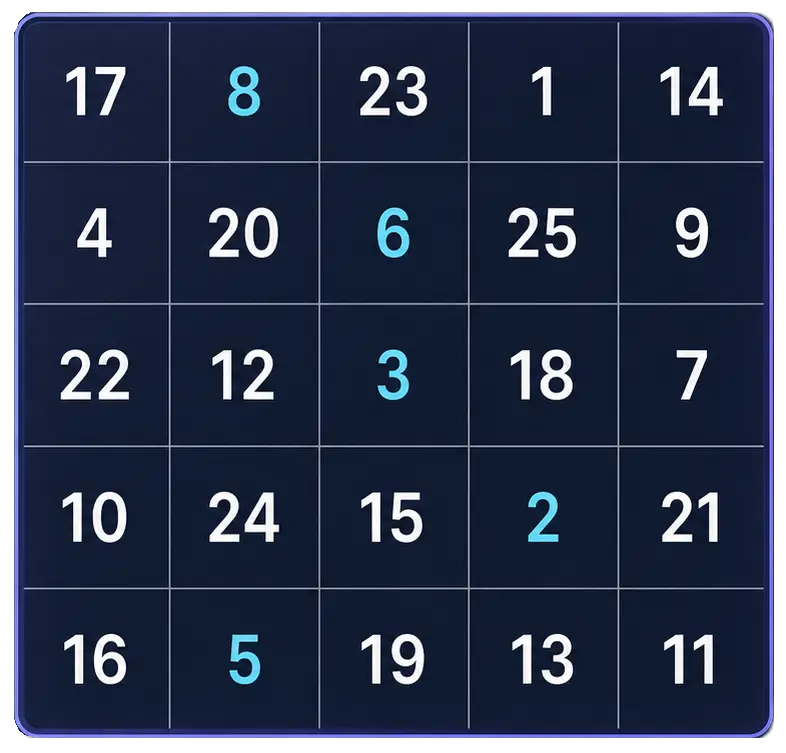
Free Schulte Table Trainer
Browser toolGoal: Cleaner 5x5 rounds with fewer mistakes
Practice Schulte tables online with a simple browser grid. Choose 3x3 through 7x7, track time and mistakes, and use pause, shuffle, and keyboard controls for quick focus sessions.
Start Free TrainerVisual Search Test
Find the target among distractors
Speed • Accuracy • Focus
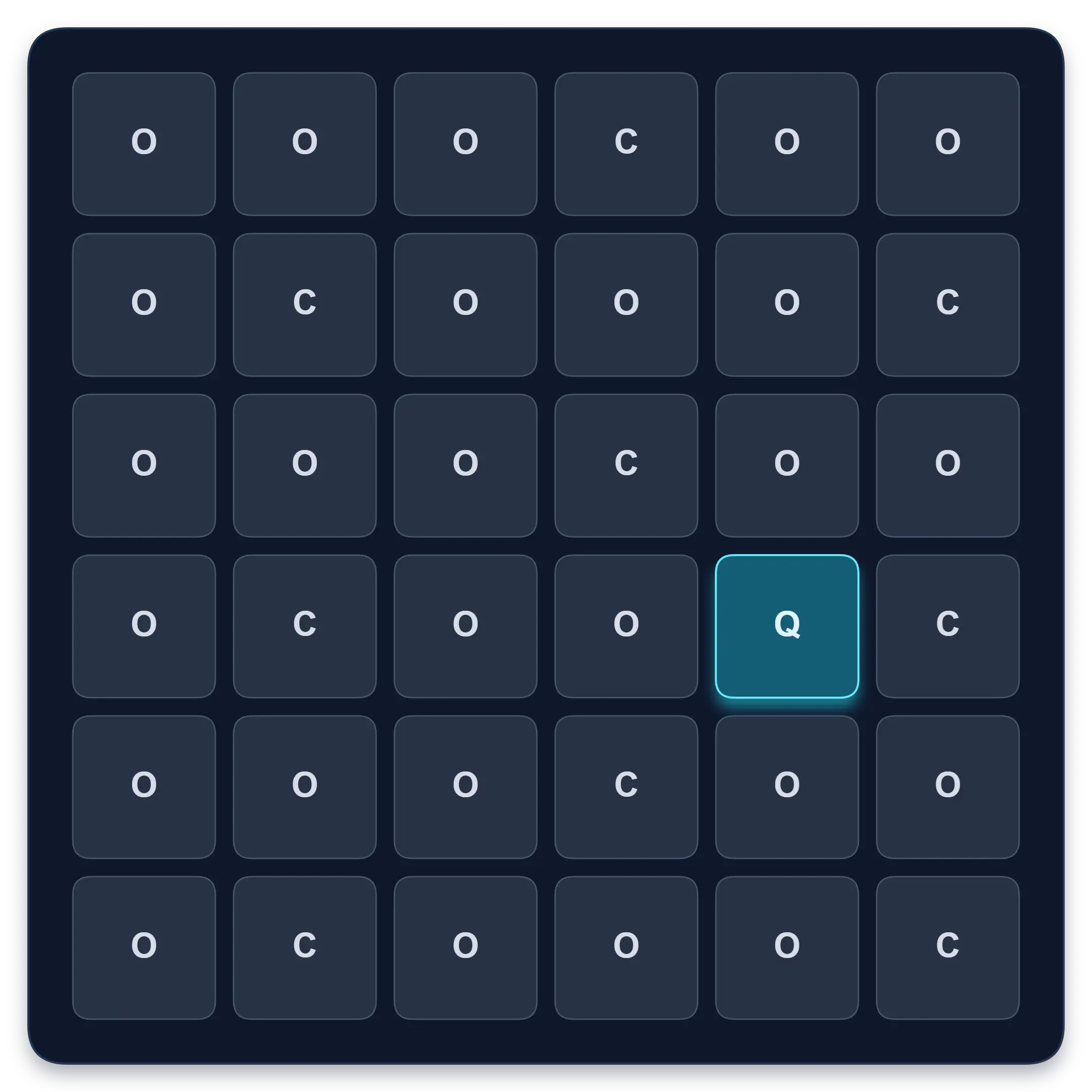
Visual Search Test
Browser toolGoal: Faster target spotting with better accuracy
Find one target among similar symbols, letters, or numbers. Complete ten short rounds and track median response time, accuracy, and clean results.
Start Visual Search TestChunking Memory Trainer
Group, recall, and reconstruct
Meaningful groups • Exact order • Repair
Meaningful groups
- 1apple
- 2pear
- 3plum
- 4ticket
- 5map
- 6train
Chunking Memory Trainer
Browser toolGoal: Recall an ordered list through meaningful groups
Practise 6, 9, or 12 words, digits, or private custom items. Build useful groups, hide the list, reconstruct every position, compare chunks, and repair weak groups.
Start Chunking TrainerContinue in the app
Use the app when you want structured sessions and longer-term tracking.
Schulte table training with progress
History, heatmaps, pace, and weekly review
History • Heatmaps • Progress
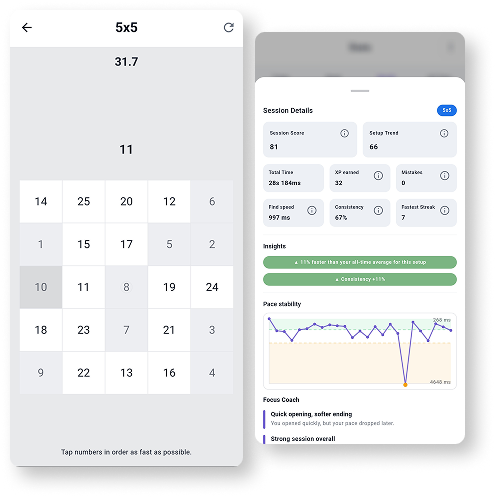
Quartenson: Schulte Tables
Available nowTrain Schulte tables on Android with session history, pace patterns, heatmaps, achievements, and weekly progress review.
Explore Schulte Tables